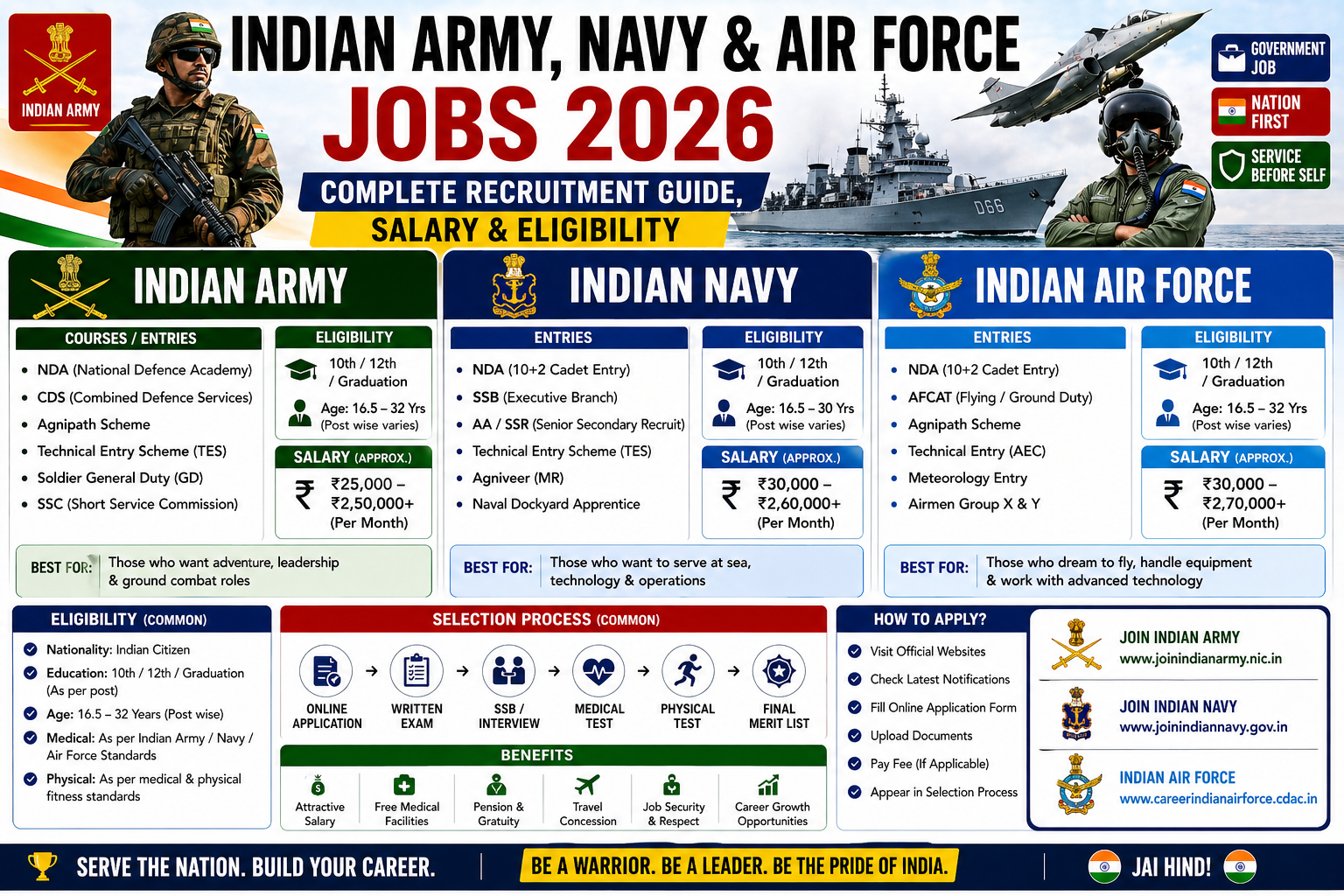
A career in India’s Armed Forces is unlike any other government job. It offers not just a salary — but a complete way of life that includes adventure, discipline, national pride, lifelong camaraderie, and one of the most comprehensive benefit packages of any employer in the country. In 2026, the Indian Army, Navy, and Air Force are actively recruiting across multiple categories — from the Agniveer scheme for young soldiers to officer entries through NDA, CDS, AFCAT, and technical schemes.
This complete guide covers every major recruitment route in all three services — salary at every rank, eligibility requirements, entry schemes, exam patterns, and how to apply — so you can plan your defence career with full clarity.
India’s Armed Forces — Structure and Entry Routes
The Indian Armed Forces have three services:
| Service | HQ | Primary Role | Official Recruitment Portal |
|---|---|---|---|
| Indian Army | New Delhi | Land warfare, border security, counter-insurgency | joinindianarmy.nic.in |
| Indian Navy | New Delhi | Maritime security, naval warfare, Coast Guard support | joinindiannavy.gov.in |
| Indian Air Force (IAF) | New Delhi | Air defence, strategic air power, transport | airmenselection.cdac.in / afcat.cdac.in |
Each service recruits through two broad categories: Officers (commissioned) and Soldiers/Sailors/Airmen (non-commissioned).
Understanding the Two Career Tracks
Track 1 — Officer (Commissioned) Entry
Officers are the leadership cadre of the Armed Forces — commanding units, making strategic decisions, and managing operations. Entry is through competitive exams like NDA (for Class 12 students) and CDS/AFCAT (for graduates), followed by SSB (Services Selection Board) interview.
Starting rank: Lieutenant (Army) / Sub-Lieutenant (Navy) / Flying Officer (IAF)
Pay Level: Level 10 (7th Pay Commission) — ₹56,100 basic pay
Career ceiling: General / Admiral / Air Chief Marshal — ₹2,50,000/month (fixed apex scale)
Track 2 — Soldier/Sailor/Airman (Non-Commissioned) Entry
Soldiers, sailors, and airmen are the operational backbone of the Armed Forces. They carry out combat, technical, logistics, and support roles under officer command. Entry is through recruitment rallies (Army), SSR/MR/AA exams (Navy), and Airmen Group X/Y selection (IAF) — plus the new Agniveer scheme.
Starting rank: Sepoy (Army) / Sailor (Navy) / Aircraftsman (IAF)
Pay: Level 3 (₹21,700/month basic) for regular soldiers
Agniveer: Special 4-year scheme (₹30,000–₹40,000/month in-hand)
Part 1 — Indian Army Jobs 2026
India’s Army is the world’s second-largest standing army with approximately 1.4 million active personnel. It recruits continuously throughout the year across multiple schemes.
Army Officer Entry Schemes 2026
| Entry Scheme | Qualification | Exam | Starting Rank | Vacancies 2026 |
|---|---|---|---|---|
| NDA (National Defence Academy) | 10+2 (any stream) | UPSC NDA exam (twice/year) | Lieutenant (after training) | ~400+ Army + Navy + Air |
| CDS (Combined Defence Services) | Graduation (any stream) | UPSC CDS exam (twice/year) | Lieutenant | ~200–300 Army slots |
| TES (10+2 Technical Entry Scheme) | 12th (PCM, 70%+) | SSB Interview only (merit-based shortlisting) | Lieutenant | ~90 posts/batch |
| SSC Tech (Short Service Commission) | B.E./B.Tech | SSB Interview | Lieutenant | 90 posts/batch |
| SSC Non-Tech (NCC Special Entry) | Graduation + NCC ‘C’ Certificate | SSB Interview | Lieutenant | 70 posts (March 2026 cycle) |
| JAG Entry (Army Legal) | LLB with 55% marks | SSB Interview | Lieutenant | 8 posts (2026) |
| SSC AFMS (Medical Officers) | MBBS / MD / MS / BDS | SSB Interview | Captain (direct) | 100 posts (2026) |
| University Entry Scheme (UES) | B.E./B.Tech (pre-final or final year) | SSB Interview | Lieutenant | Periodic |
| Territorial Army (TA) | Graduation + employed civilian | Written + SSB | Lieutenant (part-time) | 12 posts (2026) |
Army Soldier Entry Schemes 2026
| Category | Qualification | Age | Entry Route |
|---|---|---|---|
| Agniveer GD (General Duty) | 10th Pass (45% aggregate, 33% per subject) | 17.5–21 years | Rally + CEE Written + Physical |
| Agniveer Technical | 10+2 (PCM, 50%) OR ITI | 17.5–21 years | Rally + CEE Written + Physical |
| Agniveer Clerk / SKT | 10+2 (60%, English 50%) | 17.5–21 years | Rally + CEE Written + Physical |
| Agniveer Tradesman (10th) | 10th Pass with ITI | 17.5–21 years | Rally + Physical |
| Agniveer Tradesman (8th) | 8th Pass (certain trades) | 17.5–21 years | Rally + Physical |
| JCO (Religious Teacher) | Graduation | 25–34 years | Written + SSB |
| JCO (Catering) | 10+2 + Hotel Mgmt | 20–25 years | Written + SSB |
2026 Army Vacancy Numbers:
- 25,000+ Agniveer Rally posts (ongoing throughout 2026); SSC Non-Technical NCC Special Entry: 70 posts (March 2026 notification); AFMS Medical Officers SSC: 100 posts (March 2026)
Indian Army Salary — Rank-Wise 2026
Officer Rank-Wise Salary (7th Pay Commission)
| Rank | Pay Level | Basic Pay | MSP | In-Hand Salary |
|---|---|---|---|---|
| Lieutenant | Level 10 | ₹56,100 | ₹15,500 | ₹75,000–₹90,000 |
| Captain | Level 10B | ₹61,300 | ₹15,500 | ₹85,000–₹1,00,000 |
| Major | Level 11 | ₹69,400 | ₹15,500 | ₹1,00,000–₹1,20,000 |
| Lieutenant Colonel | Level 12A | ₹1,21,200 | ₹15,500 | ₹1,50,000–₹1,85,000 |
| Colonel | Level 13 | ₹1,30,600 | ₹15,500 | ₹1,60,000–₹2,00,000 |
| Brigadier | Level 13A | ₹1,39,600 | ₹15,500 | ₹1,75,000–₹2,10,000 |
| Major General | Level 14 | ₹1,44,200 | ₹15,500 | ₹1,85,000–₹2,25,000 |
| Lieutenant General | Level 15–16 | ₹1,82,200–₹2,05,400 | — | ₹2,20,000–₹2,50,000 |
| General / COAS | Level 18 | ₹2,50,000 (fixed) | — | ₹2,50,000 (apex) |
MSP (Military Service Pay): All officers from Lieutenant to Brigadier receive a fixed ₹15,500/month as Military Service Pay — compensation for the unique conditions of military service. This is over and above basic pay.
Soldier / JCO Salary
| Category | Pay Level | Basic Pay | In-Hand (Approx.) |
|---|---|---|---|
| Sepoy / GD Soldier | Level 3 | ₹21,700 | ₹30,000–₹38,000 |
| Lance Naik | Level 3 | ₹21,700–₹25,500 | ₹33,000–₹42,000 |
| Havildar | Level 5 | ₹29,200 | ₹45,000–₹55,000 |
| Naib Subedar (JCO) | Level 7 | ₹44,900 | ₹65,000–₹78,000 |
| Subedar (JCO) | Level 8 | ₹47,600 | ₹70,000–₹85,000 |
| Subedar Major (JCO) | Level 9 | ₹53,100 | ₹80,000–₹95,000 |
Agniveer Salary 2026
| Year | Monthly Package (Gross) | In-Hand (After Seva Nidhi deduction) | Seva Nidhi Contribution |
|---|---|---|---|
| Year 1 | ₹30,000 | ₹21,000 | ₹9,000 |
| Year 2 | ₹33,000 | ₹23,100 | ₹9,900 |
| Year 3 | ₹36,500 | ₹25,550 | ₹10,950 |
| Year 4 | ₹40,000 | ₹28,000 | ₹12,000 |
| Seva Nidhi on exit (75% batch) | ~₹10–₹12 lakh (tax-free) |
Agniveers also receive free food, accommodation, clothing, and medical facilities during service — making the real total compensation significantly higher than the in-hand salary alone.
Part 2 — Indian Navy Jobs 2026
The Indian Navy operates 150+ warships, submarines, and aircraft across three commands — Western (Mumbai), Eastern (Visakhapatnam), and Southern (Kochi). It recruits both officers and sailors regularly.
Navy Officer Entry Schemes 2026
| Entry Scheme | Qualification | Exam/Selection | Starting Rank | 2026 Vacancies |
|---|---|---|---|---|
| NDA (Naval Wing) | 10+2 (PCM) | UPSC NDA Exam | Sub-Lieutenant (after training) | ~75+ seats (part of NDA total) |
| 10+2 B.Tech Cadet Entry | 10+2 (PCM, 70%) | JEE Main qualified | Sub-Lieutenant (after 4-year B.Tech) | 44 posts (Jan 2026 notification) |
| CDS (Executive / Technical) | B.E./B.Tech or Graduation | UPSC CDS Exam | Sub-Lieutenant | Periodic |
| CDSE (Naval Academy / Ezhimala) | Graduation | UPSC CDS | Sub-Lieutenant | Periodic |
| SSC Officers (Various Branches) | Branch-specific degree | SSB Interview | Sub-Lieutenant | 260 posts (Feb 2026) |
| Short Service Commission (IT/Logistics/Education) | Graduation in relevant field | SSB Interview | Sub-Lieutenant | Periodic |
Navy Sailor / Agniveer Entry 2026
| Category | Qualification | Age | Post |
|---|---|---|---|
| Agniveer SSR (Senior Secondary Recruit) | 10+2 (PCM or PCB, 50%) | 17.5–21 years | Sailor (technical/medical) |
| Agniveer MR (Matric Recruit) | 10th Pass | 17.5–21 years | Sailor (cook, steward, hygienist) |
| Agniveer MR Musician | 10th Pass + musical ability | 17.5–21 years | Band duties |
Navy Agniveer SSR 2026: SSR and MR notifications released periodically throughout the year; SSC Officer recruitment 260 posts (last date February 24, 2026)
Navy Salary — Rank-Wise 2026
Navy officer pay is identical to Army officer pay at the same rank level (Level 10 = ₹56,100 for Sub-Lieutenant). The key difference is that Navy officers receive an additional Naval Allowance for sea duties, and submarine officers receive Submarine Allowance (one of the highest special allowances in the armed forces).
| Rank | Basic Pay | Sea Duty/Special Allowance | In-Hand (Approx.) |
|---|---|---|---|
| Sub-Lieutenant | ₹56,100 | ₹7,000–₹12,000 | ₹80,000–₹1,00,000 |
| Lieutenant | ₹61,300 | ₹7,000–₹12,000 | ₹90,000–₹1,10,000 |
| Lieutenant Commander | ₹69,400 | ₹10,000–₹15,000 | ₹1,05,000–₹1,25,000 |
| Commander | ₹1,21,200 | ₹12,000–₹18,000 | ₹1,55,000–₹1,90,000 |
| Captain | ₹1,30,600 | ₹14,000–₹20,000 | ₹1,65,000–₹2,05,000 |
| Rear Admiral | ₹1,44,200 | Command allowance | ₹1,90,000–₹2,30,000 |
| Vice Admiral | ₹2,05,400 | — | ₹2,40,000–₹2,50,000 |
| Admiral / CNS | ₹2,50,000 (fixed) | — | ₹2,50,000 (apex) |
Submarine Allowance: Submarine officers receive ₹13,500–₹25,000/month extra depending on sea hours — making submarine branch officers among the highest-paid in any service.
Part 3 — Indian Air Force Jobs 2026
The IAF is India’s aerospace power, operating fighters (Rafale, Su-30MKI, Tejas), transport aircraft, helicopters, and strategic bombers. It recruits both flying branch officers (pilots) and ground duty officers, plus technical and non-technical airmen.
IAF Officer Entry Schemes 2026
| Entry Scheme | Branch | Qualification | Exam | 2026 Status |
|---|---|---|---|---|
| NDA (Air Force Wing) | Flying | 10+2 (PCM) | UPSC NDA | Active (twice/year) |
| AFCAT (Air Force Common Admission Test) | Flying + Ground Duty | Graduation | AFCAT exam (twice/year) | Active |
| CDS | Flying | Graduation | UPSC CDS | Active |
| NCC Special Entry (Air Force) | Flying / Ground Duty | Graduation + NCC ‘C’ | SSB Interview only | Periodic |
| Meteorology Entry | Ground Duty | M.Sc. in Physics/Maths/Meteorology | SSB Interview | Periodic |
| Education Entry | Ground Duty | Post-Graduation | SSB Interview | Periodic |
| Legal Entry | Ground Duty | LLB | SSB Interview | Periodic |
| SSC Tech Entry (Aeronautical) | Technical Branch | B.E. / B.Tech (specific branches) | GATE Score + SSB | Periodic |
AFCAT 2026: AFCAT (Air Force Common Admission Test) is conducted twice a year — AFCAT 01/2026 and AFCAT 02/2026. It is the primary entry for non-NDA graduates into the IAF as Flying Branch (pilot) or Ground Duty Branch (Administration, Logistics, Education, Meteorology, Accounts) officers.
AFCAT Exam Pattern:
- Duration: 2 hours
- Questions: 100 (multiple choice)
- Sections: Verbal Ability in English, Numerical Ability, Reasoning & Military Aptitude, General Awareness
- Marks: 300 (3 marks each, 1 mark negative for wrong)
- EKT (Engineering Knowledge Test): Additional test for Technical Branch candidates
IAF Airmen Entry (Agniveer Vayu) 2026
| Group | Science Subjects (PCM/PCB) | Arts/Commerce | Trades | Qualification |
|---|---|---|---|---|
| Agniveer Vayu (Science) | Group X & Y | — | Technical (X), Non-technical (Y) | 10+2 PCM (50% for Group X, 50% aggregate for Group Y) |
| IAF Airmen (Medical Assistant) | Medical — PCB | — | Medical support | 10+2 PCB |
Agniveer Vayu Intake 01/2027 notifications were released in January 2026; registration was open from 12 January to 8 February 2026 at indianairforce.nic.in
IAF Salary — Rank-Wise 2026
IAF officers receive the same base pay as Army and Navy counterparts, with the Flying Allowance making flying branch officers the highest-paid among all three services at equivalent ranks.
| Rank | Basic Pay | Flying Allowance | In-Hand (Flying Branch) |
|---|---|---|---|
| Flying Officer | ₹56,100 | ₹23,750 | ₹1,05,000–₹1,25,000 |
| Flight Lieutenant | ₹61,300 | ₹23,750 | ₹1,15,000–₹1,35,000 |
| Squadron Leader | ₹69,400 | ₹23,750–₹29,000 | ₹1,25,000–₹1,55,000 |
| Wing Commander | ₹1,21,200 | ₹29,000–₹35,000 | ₹1,80,000–₹2,15,000 |
| Group Captain | ₹1,30,600 | ₹35,000–₹40,000 | ₹1,95,000–₹2,35,000 |
| Air Commodore | ₹1,39,600 | — | ₹1,90,000–₹2,30,000 |
| Air Marshal | ₹2,05,400 | — | ₹2,40,000–₹2,50,000 |
| Air Chief Marshal | ₹2,50,000 (fixed) | — | ₹2,50,000 (apex) |
Flying Allowance: IAF pilots receive ₹23,750–₹40,000/month over and above all other allowances — one of the highest special allowances in central government. This is the reason IAF flying officers take home significantly more than Army officers of the same rank.
Agniveer Vayu Salary: Same structure as Army Agniveers — ₹30,000–₹40,000 gross across 4 years, with Seva Nidhi on exit.
Armed Forces Benefits — The Complete Package
One factor that sets armed forces careers apart from all other government jobs is the comprehensive non-salary benefits package. Many of these cannot be quantified in money — they are lifestyle benefits.
| Benefit | Details | Real Value Per Month |
|---|---|---|
| Free Accommodation | Government quarters at every posting | ₹10,000–₹40,000 saved |
| Free Medical | Full family — at military hospitals (ECHS for veterans) | ₹5,000–₹15,000 equivalent |
| CSD (Canteen Stores Dept.) | Goods at 15–30% below market price (alcohol, electronics, vehicles) | ₹3,000–₹8,000 saved |
| Military Pension | 50% of last basic pay after 20 years service — for life | ₹25,000–₹1,25,000/month |
| Siachen / Field Allowance | Extra ₹14,000–₹42,500/month for harsh postings | Up to ₹42,500 extra |
| Group Insurance | ₹75 lakh–₹1 crore coverage for officers | — |
| Children Education | KV/Army school access + education allowance | ₹2,000–₹5,000/month |
| Leave Travel Concession | Annual reimbursed travel for family | — |
| AGIF (Army Group Insurance) | ₹50 lakh at ₹6,400 one-time premium | Exceptional value |
| Orderly | Personal assistant at home for officers | ₹5,000–₹10,000 value |
| Club / Sports Facilities | Access to premium sports clubs, gyms, golf courses | ₹3,000–₹8,000 value |
Pension note: Regular armed forces personnel (pre-Agniveer) receive a lifelong pension after completing service. This is perhaps the single most valuable financial benefit in any government job — a Colonel retiring at ₹1,30,600 basic draws ~₹65,300/month pension for life, with DA revisions. This benefit does not apply to Agniveers (who get Seva Nidhi instead).
NDA vs CDS vs AFCAT — Entry Route Comparison
| Factor | NDA | CDS | AFCAT |
|---|---|---|---|
| Qualification | 10+2 (Class 12) | Graduation | Graduation |
| Conducting Body | UPSC | UPSC | IAF directly |
| Services | Army, Navy, Air Force | Army, Navy, Air Force | Air Force only |
| Age | 16.5–19.5 years | 19–24 years (varies) | 20–26 years |
| Training Duration | 3 years at NDA + 1 year at service academy | 1–1.5 years at IMA/INA/AFA | 1.5–2 years at AFA |
| Commission | Permanent Commission | Permanent (IMA/INA) or SSC (OTA) | Permanent or SSC |
| Exam Frequency | Twice a year | Twice a year | Twice a year |
| Difficulty Level | High | High | Moderate |
| Starting Rank | Lieutenant after full training | Lieutenant | Flying Officer |
| Salary Post-Commission | ₹56,100 basic | ₹56,100 basic | ₹56,100 basic + flying allowance |
SSB Interview — The Common Gate for All Officers
Every officer entry into the Armed Forces requires clearing the SSB (Services Selection Board) interview — a 5-day comprehensive assessment at one of India’s SSB centres (Bhopal, Allahabad, Bangalore, Bhopal, Mysore, Varanasi, Dehradun, etc.).
SSB Tests Over 5 Days:
| Day | Test Type | What It Assesses |
|---|---|---|
| Day 1 | OIR (Officer Intelligence Rating) + PPDT (Picture Perception) | Intelligence, group dynamics, communication |
| Day 2 | Psychology Tests (TAT, WAT, SRT, SDT) | Personality, decision-making, mental agility |
| Day 3 | GTO 1 (Group Tasks — outdoor) | Leadership, teamwork, physical coordination |
| Day 4 | GTO 2 + Personal Interview | Command tasks, individual assessment |
| Day 5 | Conference | Final board assessment |
SSB Clearance Rate: Approximately 1–5% of candidates who appear for SSB are finally selected and medically fit. This is genuinely difficult — not a written exam you can purely study for. The SSB assesses innate officer-like qualities: initiative, leadership under pressure, communication, intellectual ability, and social adaptability.
Preparation tip: The most effective SSB preparation is building real-life experiences — leadership in sports/social activities, public speaking, reading newspapers, and genuine engagement with current affairs and national security issues.
Physical Standards — Armed Forces 2026
Physical fitness is the foundation of a defence career. Standards vary by service and branch:
Army Physical Standard (Soldier Level — Agniveer GD)
| Test | Standard |
|---|---|
| 1.6 km Run | Under 5 minutes 30 seconds |
| Beam / Pull-ups | Minimum 6 repetitions |
| 9 feet Ditch | Cross in one attempt |
| Balance | Zigzag balance |
| Height (General) | Minimum 170 cm |
| Chest (Male) | 77 cm (minimum) with 5 cm expansion |
| Weight | Proportionate to height |
IAF Officer Physical Standard
| Measurement | Flying Branch | Ground Duty |
|---|---|---|
| Height | 162.5–196 cm (with specific leg/thigh length) | 152 cm (minimum) |
| Vision | 6/6 each eye (no glasses for pilot) | 6/6 correctable |
| Colour Vision | CP-I (Normal) for Flying | Normal |
| BMI | 18–25 | 18–25 |
Note: Flying branch officers have the strictest vision requirements — contact lenses and glasses are not permitted for pilots at the time of initial selection. LASIK surgery may be permitted after a waiting period as per updated DGCA/IAF norms.
How to Apply — All Three Services
Indian Army
- Officers (NDA/CDS): Apply through UPSC portal — upsc.gov.in when NDA/CDS notification is live
- Officers (TES/SSC Tech): Apply at joinindianarmy.nic.in
- Soldiers/Agniveer: Apply at joinindianarmy.nic.in (rally-based; notification released zone-wise)
- Application fee: ₹0 for women; ₹250–₹500 for men (varies by scheme)
Indian Navy
- Officers (NDA): Through UPSC portal
- Officers (SSC/CDSE): Through joinindiannavy.gov.in
- Sailors/Agniveer SSR/MR: Through joinindiannavy.gov.in
- 10+2 B.Tech Cadet: Through joinindiannavy.gov.in (JEE Main score required)
Indian Air Force
- Officers (AFCAT): Apply at afcat.cdac.in when notification is live
- Officers (NDA/CDS): Through UPSC portal
- Agniveer Vayu: Apply at agnipathvayu.cdac.in
- Airmen (Medical Assistant): At airmenselection.cdac.in
Career Growth — Officer vs Soldier vs Agniveer
Officer Career Path (25–35 Year Career)
Army: Lt → Capt (2 yrs) → Major (6 yrs) → Lt Col (13 yrs) → Colonel (15 yrs) → Brigadier (25 yrs) → General grades
Navy: Sub-Lt → Lt → Lt Cdr → Commander → Captain → Rear Admiral → Vice Admiral → Admiral
IAF: Flying Officer → Flt Lt → Sqn Ldr → Wing Cdr → Gp Capt → Air Commodore → Air Marshal → Air Chief Marshal
Soldier / JCO Career Path (Pre-Agniveer)
Sepoy → Lance Naik → Naik → Havildar → Naib Subedar (JCO) → Subedar → Subedar Major
A regular soldier serves until age 55–57 and receives full pension. Promotions are time-based and merit-based with departmental exams for JCO entry.
Agniveer Career Path
4-year Agniveer service → 25% are absorbed into permanent service as regular soldiers → 75% exit with Seva Nidhi (~₹10–12 lakh tax-free) + priority in CAPF, state police, and many private sector employers.
Many states have announced reservation for Agniveers in police and state government jobs — making the post-Agniveer transition increasingly well-supported.
Which Service to Choose — Army, Navy, or Air Force?
| Choose Indian Army if… | Choose Indian Navy if… | Choose Indian Air Force if… |
|---|---|---|
| You want the largest service with most soldier vacancies | You are drawn to maritime life and sea voyages | You want to fly as a fighter or transport pilot |
| You prefer a land-focused career in diverse terrain | Your strength is technical engineering (submarine/warship systems) | You love aerospace, technology, and precision |
| You want JCO/soldier career with Agniveer scheme | You want Navy officer life with sea allowance | You want AFCAT route as a graduate |
| Class 10 pass, want soldier career immediately | 10+2 PCM with strong maths for B.Tech cadet entry | 10+2 PCM, want NDA route with flying career |
| Adventure in mountains, deserts, counter-insurgency | Adventure at sea, international port visits | Adventure in air — fighter missions, display teams |
FAQ — Defence Jobs 2026
Q1. Can girls apply for Army/Navy/Air Force 2026? Yes. Women can apply for officer entries in all three services. The Army also has women Agniveer vacancies in specific categories. IAF has women fighter pilots and women officers across all ground duty branches. Navy accepts women officers in multiple branches.
Q2. Is there an age limit for NDA? Yes — candidates must be between 16.5 and 19.5 years of age at the time of application for NDA. It is specifically for Class 12 students and recent 12th-pass candidates.
Q3. What is the difference between Permanent Commission and Short Service Commission (SSC)? Permanent Commission means a full career in the armed forces until retirement. SSC is initially for 10–14 years, after which officers can opt for Permanent Commission (subject to vacancies and performance) or leave with gratuity and a transition package.
Q4. What is Seva Nidhi in the Agniveer scheme? Seva Nidhi is the exit financial package for Agniveers who complete 4 years of service and are not retained. The total corpus is approximately ₹10–12 lakh, tax-free — consisting of the Agniveer’s own contribution (30% of monthly package) matched by an equal government contribution.
Q5. Do defence officers get pension? Regular armed forces officers (pre-Agniveer scheme) receive a pension after completing 20 years of service. Agniveers do not receive a pension — they receive the Seva Nidhi package on exit and are covered by ECHS if retained.
Final Word
A career in the Indian Army, Navy, or Air Force in 2026 offers a salary range from ₹21,000–₹30,000 in-hand for an Agniveer to ₹2,50,000/month for the service chief — one of the widest salary spectrums in any government career. But the salary is only one part of why millions of young Indians aspire to wear the uniform.
The Armed Forces offer accommodation, medical care for life, canteen access, military pension, and the unique pride of serving as a defender of India’s sovereignty. These non-monetary benefits add ₹20,000–₹60,000 per month in real equivalent value to the compensation package of every defence personnel.
Whether you target the Agniveer scheme as a fresh Class 10 pass candidate, NDA as a Class 12 student, or CDS/AFCAT as a graduate — start physical preparation today, begin your subject preparation, and apply through official portals only.
Preparing for NDA, CDS, AFCAT, or Agniveer written exams? Practice topic-wise Mathematics, General Science, English, and General Awareness MCQs for free on PadhLe Buddy. Start your defence exam preparation today!