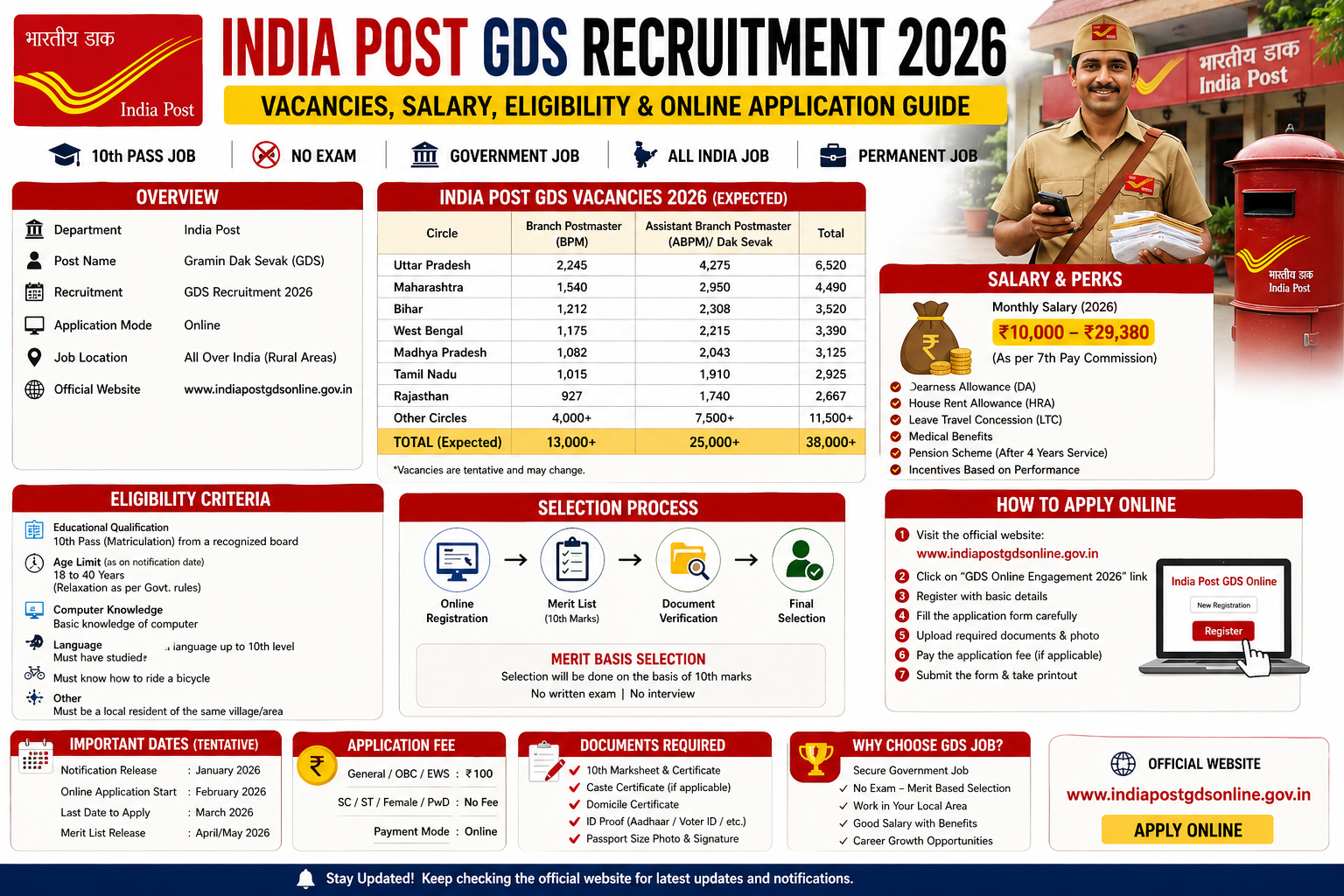
India Post’s Gramin Dak Sevak (GDS) recruitment 2026 is one of the largest and most unique government job drives in India — offering 28,636 vacancies across 23 postal circles for 10th pass candidates with no written examination. If you passed Class 10 with good marks and want a stable central government job in your home state, the GDS recruitment is the most accessible path to a government career available in India today.
What makes GDS recruitment truly unique is the merit-based selection system — your 10th standard percentage determines your position in the merit list, with no competitive exam, no physical test, and no interview. For candidates who have done well in Class 10, this is one of the most straightforward government recruitment processes in the country.
This complete guide covers everything about India Post GDS 2026 — post-wise vacancies, salary structure, eligibility, the merit list process, current status, and how to apply for the next recruitment cycle.
What Is India Post GDS? — Understanding the Role
Gramin Dak Sevak (GDS) are the frontline field workers of India’s postal department — the Department of Posts, Ministry of Communications. They operate at the most local level of India’s postal network, serving rural and semi-urban communities across the country through Branch Post Offices (BPOs).
GDS employees handle a wide range of responsibilities including mail delivery, selling stamps and postal products, managing savings accounts (Post Office Savings Schemes), accepting deposits under government schemes like Sukanya Samriddhi Yojana and PPF, and serving as the last-mile link between government services and rural India.
Important legal note from the official notification: GDS are not regular government employees — they are holders of Civil Posts outside the civil services of the state. Their service conditions are governed by the GDS Rules 2020, not the standard Central Government Service Rules. Their emoluments (called TRCA — Time Related Continuity Allowance) are not at par with 7th Pay Commission scales. They are required to work a minimum of 4 hours and maximum of 5 hours per day, and they are expected to have another source of income besides GDS emoluments. Understanding this distinction before applying is essential.
GDS Posts — Three Types of Positions
All GDS recruitment covers three distinct post types, each with different responsibilities and salary levels:
| Post | Full Form | Where Posted | Key Responsibility | TRCA Range |
|---|---|---|---|---|
| BPM | Branch Post Master | Branch Post Office (rural) | Manages and runs a Branch Post Office single-handedly | ₹12,000–₹29,380/month |
| ABPM | Assistant Branch Post Master | Branch Post Office | Assists BPM in all postal operations | ₹10,000–₹24,470/month |
| DS | Dak Sevak | Departmental / Head Post Office | Mail delivery, sorting, and distribution | ₹10,000–₹24,470/month |
BPM vs ABPM — Key Difference: The Branch Postmaster (BPM) is responsible for the complete management of a Branch Post Office, including maintaining accounts, handling postal transactions, and representing India Post in the village. BPMs are also required to arrange accommodation for the Branch Post Office at their own cost — a significant responsibility that distinguishes this post from other government jobs. ABPM posts are assistants and carry no such housing obligation.
India Post GDS Recruitment 2026 — Key Highlights
| Parameter | Details |
|---|---|
| Recruiting Body | Department of Posts, Ministry of Communications |
| Advertisement No. | 17-37/2025-GDS (Pt.I) |
| Total Vacancies | 28,636 (GDS/BPM/ABPM across 23 postal circles) |
| Notification Released | 31 January 2026 |
| Application Window | 31 January – 16 February 2026 (closed) |
| Selection Process | System-generated merit list based on Class 10 marks — NO written exam |
| 1st Merit List | Released 6 March 2026 |
| 2nd Merit List | Released 10 April 2026 |
| 3rd Merit List | Expected May 2026 |
| Official Portal | indiapostgdsonline.gov.in |
| Official GDS Engagement Page | indiapost.gov.in/gdsonlineengagement |
Circle-Wise Vacancy Distribution 2026
India Post operates across 23 postal circles — broadly aligned with states. The 28,636 vacancies are distributed across all circles, with states having larger rural areas and more Branch Post Offices commanding a higher share of vacancies.
| Postal Circle | Approximate Vacancies |
|---|---|
| Uttar Pradesh | 4,000–5,000 (highest) |
| Rajasthan | 2,500–3,000 |
| Maharashtra | 2,000–2,500 |
| Bihar | 2,000–2,500 |
| Madhya Pradesh | 1,800–2,200 |
| Gujarat | 1,200–1,500 |
| West Bengal | 1,000–1,400 |
| Karnataka | 900–1,200 |
| Andhra Pradesh | 800–1,100 |
| Odisha | 700–1,000 |
| Jharkhand | 600–900 |
| Tamil Nadu | 600–800 |
| Punjab | 500–700 |
| Haryana | 400–600 |
| Chhattisgarh | 400–600 |
| Assam | 400–500 |
| Himachal Pradesh | 300–500 |
| Uttarakhand | 300–400 |
| Kerala | 300–400 |
| Telangana | 300–400 |
| Delhi | 100–200 |
| J&K | 200–300 |
| North East (7 states) | 300–500 combined |
Note: Exact circle-wise vacancy numbers are released officially at indiapost.gov.in/gdsonlineengagement. Figures above are based on the 2026 notification pattern. UP, Rajasthan, Bihar, and Maharashtra consistently have the highest GDS vacancy counts due to their large rural postal networks.
Eligibility Criteria — India Post GDS 2026
Educational Qualification
- Minimum: Secondary School Examination Pass Certificate (Class 10) with passing marks in both Mathematics and English from any board recognized by the Government of India, State Governments, or Union Territories
- No higher qualification required: Graduation and post-graduation are accepted, but graduates do NOT get any preference over 10th-pass candidates — selection is purely on 10th marks
- Local Language Compulsory: Must have studied the local language of the postal circle up to at least Class 10 level. Lack of local language proficiency is grounds for rejection at document verification — this is strictly enforced
Age Limit
- Minimum: 18 years
- Maximum: 40 years
- Age calculated as on the last date of application submission (16 February 2026 for current cycle)
Age Relaxation:
| Category | Relaxation |
|---|---|
| SC / ST | 5 years |
| OBC | 3 years |
| PwD (General) | 10 years |
| PwD (SC/ST) | 15 years |
| PwD (OBC) | 13 years |
| Ex-Servicemen | As per government rules |
| Transwomen | 5 years |
Other Requirements
- Basic computer knowledge is mandatory — BPMs and ABPMs use computer systems for postal transactions, savings account operations, and government scheme registrations
- Cycling ability — GDS employees may need to use bicycles for mail delivery on assigned beats; basic cycling proficiency is required
- Willingness to serve in rural/semi-urban areas — GDS posts are predominantly in villages and small towns, not in cities
India Post GDS Salary 2026 — TRCA Structure
GDS emoluments are paid as TRCA (Time Related Continuity Allowance) — a unique pay structure specifically for GDS employees, separate from the 7th Pay Commission scales used by regular central government employees.
| Post | Minimum TRCA | Maximum TRCA | Annual Increment |
|---|---|---|---|
| Branch Post Master (BPM) | ₹12,000/month | ₹29,380/month | 3% of TRCA per year |
| Asst. Branch Post Master (ABPM) | ₹10,000/month | ₹24,470/month | 3% of TRCA per year |
| Dak Sevak (DS) | ₹10,000/month | ₹24,470/month | 3% of TRCA per year |
Additional Allowances on TRCA
In addition to TRCA, GDS employees are entitled to:
- Dearness Allowance (DA) on TRCA: DA as declared by the Government of India periodically — added on top of TRCA; currently adds approximately 40–50% of TRCA to gross pay
- GDS Gratuity: Lump sum payment at the end of service (different formula from regular government gratuity)
- Service Discharge Benefit Scheme (SDBS): A social security benefit scheme for GDS employees — both employee and government contribute; provides a benefit on discharge from service
- Children Education Allowance: Available for GDS employees with school-going children
What a BPM Actually Earns — Real Numbers
A newly joined BPM at minimum TRCA of ₹12,000/month receives:
- TRCA: ₹12,000
- DA @ ~50%: ₹6,000
- Total monthly emolument: ~₹18,000/month
After 10 years of service (3% annual increment on TRCA):
- TRCA grows to approximately ₹16,120/month
- With DA @ 50%: Total ~₹24,180/month
At maximum TRCA of ₹29,380 (long service):
- TRCA: ₹29,380
- DA: ~₹14,690
- Total: ~₹44,070/month
Transparency note: GDS salary is significantly lower than regular postal department employees like Postal Assistants or Postmen. The official notification explicitly states that GDS employees should have another source of income for adequate livelihood. This is a part-time (4–5 hours/day) government engagement — not a full-time government job in the traditional sense. Factor this into your career decision.
Selection Process — No Exam, Pure Merit
The most attractive feature of GDS recruitment — and what makes it accessible to lakhs of 10th pass candidates — is the complete absence of any written examination or interview.
How the Merit List Is Prepared
Step 1 — Mark Calculation:
- If the candidate’s 10th board gives marks (e.g., CBSE, UP Board, Bihar Board): Percentage is calculated directly to 4 decimal places for precision
- If the board gives grades (e.g., CBSE’s CGPA system): Grades are converted to equivalent percentages using a standard conversion table
- Subjects considered: Best of 5 subjects including Mathematics and English (which are compulsory)
Step 2 — Merit List Generation:
- System automatically ranks all applicants in a circle/division by descending percentage
- Category-wise lists are prepared separately (UR/OBC/SC/ST/EWS/PwD)
- Number of candidates shortlisted = number of vacancies in each category
Step 3 — Tie-Breaking Rules: If two candidates have identical 10th percentage, the following tie-breakers apply in order:
- Older candidate gets preference (date of birth)
- Female candidates get priority over male candidates within the same category
- Category priority order within tie: ST Female → SC Female → OBC Female → EWS Female → UR Female → ST Male → SC Male → OBC Male → EWS Male → UR Male
High competition note: States like UP, Bihar, and Rajasthan have extremely high cutoffs due to large applicant pools. In some divisions, even 95%+ in Class 10 may not guarantee selection in General category. Check previous year cutoffs for your specific circle and division before applying.
After Merit List — Document Verification (DV)
Shortlisted candidates are called for Document Verification at the Division Office of their postal circle. Candidates must appear with:
- Original Class 10 Certificate and Marksheet
- Class 10 admit card / hall ticket (some circles ask for this)
- Caste/Category certificate (SC/ST/OBC/EWS — in central government format)
- Local language proficiency proof (Class 10 certificate showing local language studied)
- PwD certificate (if applicable)
- Age proof (as per 10th certificate)
- 2 sets of self-attested photocopies of all above documents
Failure to appear at DV = automatic cancellation of candidature. There is no second chance.
After successful DV, a provisional engagement letter is issued by the system automatically. Candidates must complete pre-engagement formalities within 30 days. Final appointment order is issued after all verification reports are satisfactory.
Current Status — India Post GDS 2026
For the January 2026 cycle (28,636 vacancies):
| Stage | Date | Status |
|---|---|---|
| Notification Released | 31 January 2026 | ✅ Done |
| Application Window Closed | 16 February 2026 | ✅ Done |
| Correction Window | 18–19 February 2026 | ✅ Done |
| 1st Merit List Released | 6 March 2026 | ✅ Released |
| 2nd Merit List Released | 10 April 2026 | ✅ Released |
| 3rd Merit List | Expected May 2026 | ⏳ Awaited |
| Document Verification | Ongoing (circle-wise schedule in PDFs) | 🔄 In progress |
Candidates who were shortlisted in either the 1st or 2nd merit list are currently completing Document Verification at their respective division offices. Those not selected in the first two lists are awaiting the 3rd merit list.
How to Apply — Step-by-Step (For Future Cycles)
India Post conducts GDS recruitment in multiple cycles throughout the year. If you missed the January 2026 cycle, the next notification is expected later in 2026. The application process is fully online:
Step 1 — Visit the Official Portal Go to indiapostgdsonline.gov.in — this is the only official application portal. Do not apply through any third-party website.
Step 2 — New Registration Click “New Registration” → Enter your mobile number and email ID → Verify via OTP → Set a password → Note your Registration ID carefully.
Step 3 — Fill Application Form Log in with Registration ID → Select your state and division → Enter:
- Personal details (name, DOB, category, PwD status)
- Educational details (Class 10 board, year, marks/CGPA, roll number)
- Contact and address details
- Local language details
Step 4 — Select Post Preferences Choose which post(s) you want to apply for (BPM / ABPM / DS) in order of preference. If shortlisted for more than one post, only the first preference is offered — candidature for remaining posts is cancelled.
Step 5 — Upload Documents
- Passport-size photograph: White background, recent, JPEG format
- Signature: Black ink on white paper, JPEG format
- Class 10 marksheet (scanned clearly)
- Caste certificate (if applicable, in prescribed format)
Step 6 — Pay Application Fee
- General / OBC / EWS: ₹100
- Female / SC / ST / PwD / Transwomen: Exempt (Fee Waived)
- Payment via Credit/Debit Card, Net Banking, or UPI
Step 7 — Final Submission Review all details carefully → Submit the form → Download and save the confirmation page with Application Reference Number.
Important: You can apply to multiple postal circles, but each circle requires a separate application and separate fee payment. Final selection is limited to one post only.
GDS Career Growth — What Comes Next?
While GDS is part-time and not a regular government job, it does offer meaningful promotion opportunities:
| Path | Details |
|---|---|
| GDS → Postman / Mail Guard | Via departmental competitive examination — converts to regular central government post (Level 1, 7th CPC, ₹18,000 basic pay) |
| GDS → Postal Assistant / Sorting Assistant | Via departmental exam (PA/SA exam) — higher Level 4 post (₹25,500 basic pay) |
| GDS → Multi-Tasking Staff (MTS) | Internal departmental process in some circles |
The promotion from GDS to Postman or PA/SA is a significant career milestone — it transitions you from a Civil Post holder to a regular central government employee with full 7th Pay Commission entitlements, pension under NPS, CGHS medical, and all central government benefits.
Documents Required — Quick Checklist
Keep these ready before applying and for Document Verification:
- Class 10 pass certificate (original + 2 photocopies)
- Class 10 marksheet (original + 2 photocopies)
- Local language certificate (proof that local language was studied up to Class 10)
- Date of birth proof (Class 10 certificate usually serves this purpose)
- Category/Caste certificate (SC/ST/OBC — must be in central government format)
- EWS certificate (if applicable — must be current financial year)
- PwD certificate (if applicable — from competent medical authority)
- Ex-serviceman discharge book (if applicable)
- Recent passport-size photographs (minimum 4–6)
- Valid government-issued ID proof (Aadhaar / Voter ID / PAN)
- Computer knowledge certificate (from recognized institute, if available — not mandatory but useful)
FAQs — India Post GDS Recruitment 2026
Q1. Is there any written exam for GDS recruitment 2026? No. Selection is entirely merit-based on Class 10 marks. No written examination, no physical test, no interview is conducted at any stage.
Q2. Can graduates apply for GDS recruitment? Yes — any graduate can apply as long as they meet the age limit and local language requirement. However, being a graduate gives no extra marks or preference. Selection is based purely on 10th percentage.
Q3. What is the minimum 10th percentage required to get selected? There is no minimum cutoff fixed by India Post. Selection depends on competition in each circle/division/category. In high-competition states (UP, Bihar, Rajasthan), cutoffs in General category can be as high as 90–95%.
Q4. Can I apply to multiple circles? Yes — you can apply to multiple circles. Each circle requires a separate application and separate fee. However, if selected in multiple circles, you will be offered only one post (first preference circle).
Q5. Is GDS a permanent government job? GDS is a Civil Post — not a permanent regular government job. GDS employees cannot be retained beyond age 65. Their service conditions are governed by GDS Rules 2020, separate from central government service rules.
Q6. When is the next GDS recruitment cycle? India Post conducts multiple GDS recruitment cycles per year. The January 2026 cycle (current) had 28,636 vacancies. A second cycle for 2026 is expected later in the year. Keep checking indiapost.gov.in/gdsonlineengagement for updates.
Final Word
India Post GDS Recruitment 2026 is the most accessible government job for 10th pass candidates in India — with 28,636 vacancies, zero exam requirement, and a transparent merit-based selection process. The salary (₹10,000–₹29,380/month TRCA + DA) is modest compared to regular government posts, but the job offers stability, home-state posting, social security benefits, and a pathway to higher postal department positions through departmental promotion exams.
For candidates with strong Class 10 marks and a local language proficiency match for their target circle, GDS is the fastest route to a central government job in India. The January 2026 cycle’s 3rd merit list is expected in May 2026 — after which a fresh notification for the next cycle is anticipated.
Monitor indiapostgdsonline.gov.in and indiapost.gov.in/gdsonlineengagement regularly so you never miss the next recruitment window.
Preparing for GDS departmental promotion exams like PA/SA or Postman? Practice General Knowledge, Reasoning, and English MCQs topic-wise on PadhLe Buddy for free. Start your quiz today!