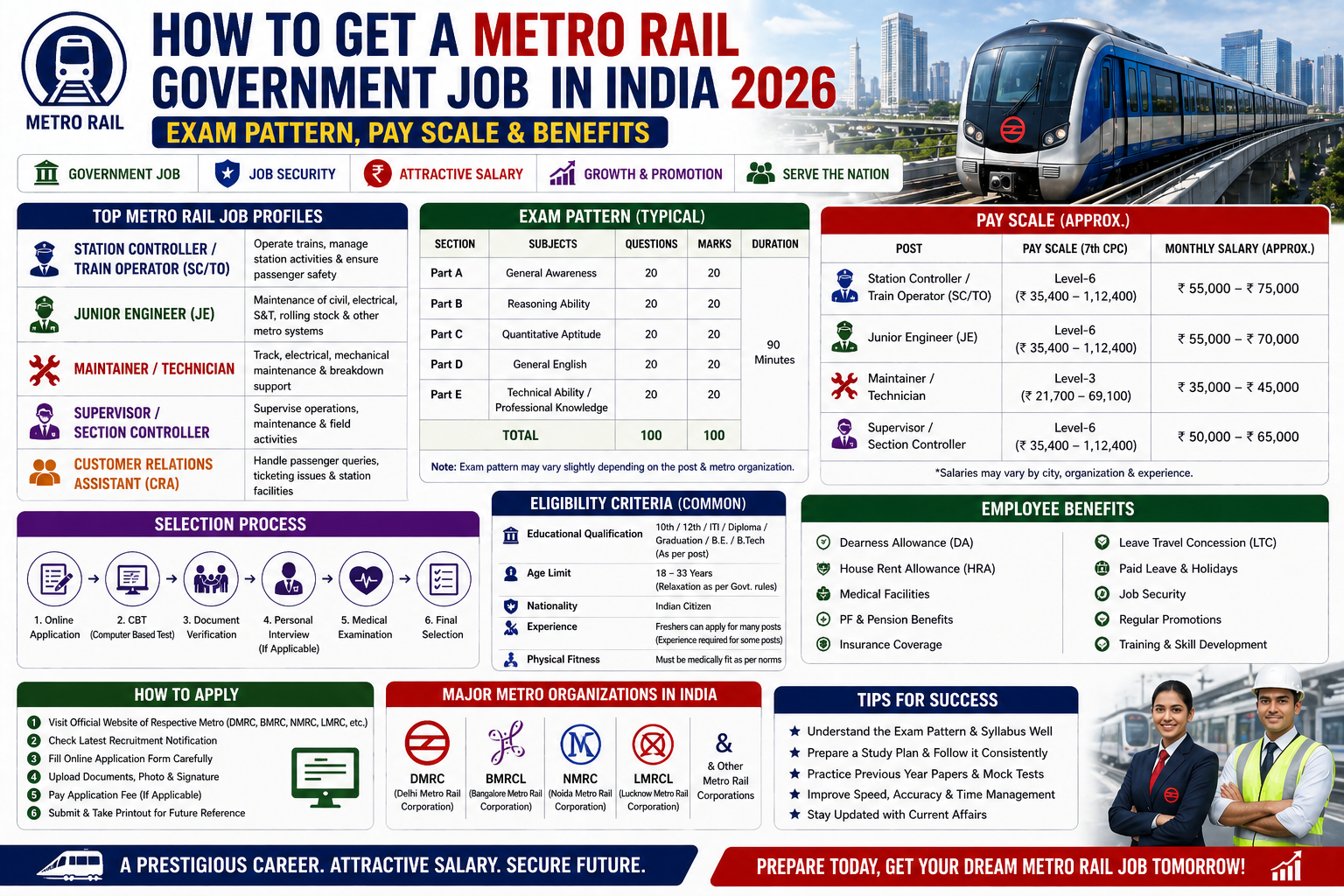
Metro rail jobs are among the most desirable government-sector jobs in India — combining PSU-level salaries, modern work environments, urban postings, and strong job security. Yet most candidates are confused about one fundamental question: how exactly do you get a metro rail government job in India?
Unlike Indian Railways, where a single national body (RRB) handles all recruitment, each metro corporation in India recruits independently through its own notification, exam, and selection process. DMRC, BMRCL, UPMRC, NMRC, CMRL, and 15+ other corporations each conduct their own recruitment drives — meaning there is not one path into metro jobs, but many simultaneous paths depending on your qualification, city preference, and target post.
This complete guide explains the full roadmap — from understanding eligibility and choosing the right post, to cracking the exam and completing the joining process — for every major metro rail corporation in India in 2026.
Step 1 — Understand the Metro Rail Job Hierarchy
The first step to getting a metro job is understanding which category of posts you are eligible for. Metro corporations divide all positions into two broad categories:
Executive Posts (Officer Level)
| Post | Typical Eligibility | Nature of Work |
|---|---|---|
| Assistant Manager (AM) | B.E./B.Tech or MBA/CA/LLB (post-specific) | Management, planning, policy, administration |
| Junior Engineer (JE) | B.E./B.Tech or 3-year Diploma | Technical supervision, system maintenance |
| Station Controller / Train Operator (SC/TO) | B.Sc. (Physics/Math) or B.E./B.Tech | Station operations + train driving |
| Customer Relations Assistant (CRA) | Any Graduation | Passenger services, ticketing, complaints |
| Accounts Assistant (AA) | B.Com or CA Inter | Finance, accounts, billing |
| Junior Translator / Stenographer | As per notification | Language and secretarial functions |
Non-Executive Posts (Technical Trades)
| Post | Typical Eligibility | Nature of Work |
|---|---|---|
| Maintainer (Electrician) | 10th + ITI (Electrician) | Electrical systems, wiring, distribution |
| Maintainer (Electronic Mechanic) | 10th + ITI (Electronics) | Signalling, AFC, communication systems |
| Maintainer (Fitter / Mechanic) | 10th + ITI (Fitter) | Mechanical maintenance, rolling stock |
| Maintainer (HVAC / AC) | 10th + ITI (RAC) | Air conditioning, tunnel ventilation |
| Junior Maintainer | 10th + ITI (any relevant trade) | Assist in maintenance operations |
Rule of thumb: If you have ITI certification, target Maintainer posts. If you have a Diploma, target JE posts. If you have B.Sc. in Physics/Math, target SC/TO. If you have B.E./B.Tech, target JE or AM posts. If you have any graduation, CRA is always accessible.
Step 2 — Know the Eligibility Requirements
While each metro corporation specifies its own eligibility in each notification, the general pattern across all major metro corporations is:
Educational Qualification (Standard Pattern)
| Category | Qualification Required |
|---|---|
| Maintainer (ITI) | 10th Pass + 2-year ITI in relevant trade (NCVT/SCVT recognized) |
| Junior Engineer | 3-year Diploma in Engineering OR B.E./B.Tech |
| Station Controller | B.Sc. with Physics & Math OR B.E./B.Tech (any branch) |
| Customer Relations Assistant | Any Graduation (50% or above in most cases) |
| Assistant Manager | B.E./B.Tech / MBA / CA / LLB depending on department |
Age Limits (Standard Pattern)
| Post Category | General | OBC | SC/ST | PwD |
|---|---|---|---|---|
| Maintainer (Non-Executive) | 18–25 years | 18–28 years | 18–30 years | +10 years |
| JE / SC/TO / CRA (Executive) | 18–28 years | 18–31 years | 18–33 years | +10 years |
| Assistant Manager | 18–28 years | 18–31 years | 18–33 years | +10 years |
| Senior / Deputation Posts | Up to 55 years | — | — | — |
Important: Age limits vary by notification and corporation. The figures above represent the most common pattern observed across DMRC, UPMRC, and NMRC recruitment cycles. Always verify from the specific official notification PDF before applying.
Physical & Medical Standards
Metro rail jobs — especially operational posts like SC/TO and Train Operator — require strict medical fitness:
| Standard | SC/TO / Train Operator | JE / AM | Maintainer |
|---|---|---|---|
| Vision | 6/6 both eyes (with/without correction) | Normal correctable vision | Normal vision |
| Colour Blindness | Disqualifying — zero tolerance | Minor issues sometimes acceptable | No colour blindness |
| Hearing | No hearing impairment | Standard | Standard |
| General Fitness | DMRC Medical Category C-1 | Standard fitness | Standard fitness |
| Colour Vision Test | Ishihara test mandatory | As per medical exam | Standard check |
Check your colour vision and eyesight before applying for SC/TO posts. Many well-prepared candidates are rejected at the final medical stage because of undetected colour blindness — a simple optometrist visit before applying prevents this disappointment.
Step 3 — Choose Your Target Corporation and Post
With 20+ metro corporations recruiting independently, a strategic application approach dramatically improves your chances of selection in 2026.
Corporation-Wise Recruitment Frequency
| Corporation | Recruitment Frequency | Best Posts for Freshers |
|---|---|---|
| DMRC (Delhi) | Annual / semi-annual; most frequent | Maintainer, SC/TO, JE, CRA |
| UPMRC (Lucknow/Kanpur/Agra) | Annual (unified for 3 cities) | Station Controller, JE, Maintainer |
| BMRCL (Bengaluru) | When new metro phases open | JE, AM, Maintainer |
| CMRL (Chennai) | Periodic large batches | All posts; known for higher packages |
| NMRC (Noida) | Smaller and less frequent | CRA, Maintainer, AM |
| GMRC (Ahmedabad/Surat) | Periodic | JE, Maintainer |
| KMRL (Kochi) | Periodic | AM, JE |
| Maha Metro (Nagpur/Pune) | Periodic | JE, AM, Maintainer |
| MMRDA (Mumbai) | With new line commissioning | Senior technical posts |
| JMRC (Jaipur) | Infrequent | General posts |
Best strategy for 2026: Apply to DMRC and UPMRC simultaneously — both recruit the same post types (Maintainer, SC/TO, JE, CRA) with nearly identical exam syllabuses. Preparing for one automatically prepares you for the other.
Step 4 — Understand the Selection Process
Despite each corporation holding its own exam, the selection process follows a standard 4–5 stage pattern across all major metro rail recruiters.
Stage 1 — Computer-Based Test (CBT)
The CBT is the primary selection stage — only candidates who score above the cutoff are called for further stages. This is the stage where the majority of applicants are eliminated.
General CBT Structure (All Metro Corporations):
| Section | Questions | Marks | Notes |
|---|---|---|---|
| General Awareness & Current Affairs | 15–25 | 15–25 | Metro-specific GK often asked |
| Quantitative Aptitude / Numerical Ability | 15–20 | 15–20 | Up to Class 10 level |
| General Intelligence & Reasoning | 15–25 | 15–25 | Verbal + non-verbal |
| English Language | 10–15 | 10–15 | Grammar, comprehension, vocabulary |
| Technical / Post-Specific Subject | 25–40 | 25–40 | Highest weightage section |
| Total | 80–120 | 80–120 |
Duration: 90–120 minutes | Negative Marking: 1/3 per wrong answer (most corporations) | Mode: Fully online, proctored CBT
Stage 2 — Group Discussion (GD)
Applicable for Assistant Manager (AM) posts only in most corporations. GD evaluates:
- Ability to articulate and defend a position
- Team communication and listening skills
- General awareness and current affairs knowledge
- Domain-relevant knowledge for specialized AM roles
Not applicable for JE, SC/TO, Maintainer, or CRA posts in most corporations.
Stage 3 — Personal Interview (PI)
Applicable for Executive posts (AM and some JE positions). PI evaluates:
- Technical depth in the relevant engineering or management domain
- Situational judgment and problem-solving approach
- Communication, clarity, and professional presentation
- Domain knowledge (metro systems, safety protocols, relevant regulations)
Stage 4 — Trade Test / Practical Test
Applicable for Maintainer posts — a practical skill demonstration in the candidate’s ITI trade. Typically qualifying in nature (pass/fail, not scored). Tests:
- Identification of electrical/electronic/mechanical components
- Basic fault diagnosis and repair simulation
- Safety procedures in trade operations
Stage 5 — Psychometric / Aptitude Test
Applicable specifically for SC/TO (Station Controller / Train Operator) posts — unique to operational staff recruitment. Tests:
- Reaction time and decision speed
- Spatial awareness and pattern recognition
- Concentration and attention span under simulated pressure
- Operational judgment scenarios
This test cannot be “studied for” in the traditional sense — it assesses inherent cognitive abilities. However, regular practice with online reaction time games and attention exercises can improve performance.
Stage 6 — Medical Examination
Mandatory for all posts. Medical standards are post-dependent:
- SC/TO and Train Operator: C-1 category (strictest — full fitness, no colour blindness, 6/6 vision)
- JE and AM: Standard fitness; minor corrections acceptable
- Maintainer: Standard fitness; no colour blindness in most trades
Stage 7 — Document Verification
Final stage before appointment — candidates must produce original documents matching all information submitted during application. Any mismatch causes cancellation of candidature.
Step 5 — Know the Pay Scale (IDA Pattern)
Metro rail corporations follow the IDA (Industrial Dearness Allowance) pay scale — a PSU-specific structure that is distinct from the 7th Pay Commission used by Indian Railways. IDA is revised quarterly based on the Consumer Price Index, making metro salaries more dynamic and inflation-responsive than central government salaries.
Metro Rail IDA Pay Scale — Post-Wise Overview
| Post | Pay Scale (IDA) | Basic Pay (Starting) | In-Hand Salary |
|---|---|---|---|
| Assistant Manager | E-1 Level | ₹40,000–₹50,000 | ₹65,000–₹90,000 |
| Junior Engineer | E-0 / NE-6 | ₹35,000–₹40,000 | ₹55,000–₹70,000 |
| Station Controller / TO | NE-3 (DMRC) | ₹37,000 | ₹58,000–₹72,000 |
| Customer Relations Assistant | NE-2 | ₹30,000 | ₹45,000–₹58,000 |
| Maintainer (ITI) | NE-1 | ₹25,000 | ₹38,000–₹48,000 |
How Metro Rail IDA Salary Is Calculated
Every metro employee’s gross salary consists of:
Basic Pay + IDA (120–130% of Basic) + HRA (20–30% of Basic) + Perks (35–47% of Basic) + Transport Allowance
Example — DMRC Station Controller (Delhi):
- Basic Pay: ₹37,000
- IDA @ 120%: ₹44,400
- HRA @ 30% (Delhi X-class): ₹11,100
- Perks @ 35%: ₹12,950
- TA: ₹2,500
- Gross: ~₹1,07,950
- Less EPF + Tax deductions: ~₹15,000–₹18,000
- In-Hand: ~₹60,000–₹72,000/month
This is for a fresh SC/TO joining DMRC in Delhi — without any experience or seniority. The 3% annual increment on basic pay, combined with quarterly IDA revisions, means the salary increases meaningfully every year.
Step 6 — Know the Full Benefits Package
Metro rail jobs are not just about the in-hand salary. The complete benefits package adds significant real value every month:
| Benefit | Details | Real Value Per Month |
|---|---|---|
| Free Metro Pass | Self + family — free unlimited travel | ₹1,000–₹3,000 saved |
| Concessional Home Loan | ₹15–20 lakh at 4–6% (below market rate) | EMI savings of ₹3,000–₹6,000 |
| DMRC / Metro Quarters | Subsidized / free accommodation in metro colonies | ₹5,000–₹15,000 rent saved |
| Medical Coverage | Cashless treatment at empanelled hospitals for self + family | ₹2,000–₹8,000 equivalent |
| EPF + Employer Contribution | 12% employer EPF contribution on basic + DA | Long-term wealth building |
| Gratuity | Lump sum on retirement / 5-year service completion | Post-service financial security |
| LTC (Leave Travel Concession) | Annual family travel reimbursement | ₹500–₹2,000/month equivalent |
| Group Insurance | Life + accident coverage | ₹300–₹1,000/month equivalent |
| Paternity / Maternity Leave | As per PSU norms (more generous than most private employers) | Non-monetary but significant |
| Annual Increment | 3% of basic pay per year | ₹750–₹1,500 increase per year |
| Training & Skill Development | DMRC Training Institute; IIT Delhi Metro Diploma (Executives) | Career advancement |
When you add the real monthly value of all non-salary benefits, a DMRC Maintainer with ₹42,000 in-hand salary is effectively earning the equivalent of ₹55,000–₹60,000 compared to a private sector employee with no such benefits.
Step 7 — How to Apply for Metro Rail Jobs 2026
Online Application Process (Applicable to All Major Corporations)
Step 1 — Find the Notification Visit the official careers page of the target corporation and download the PDF notification. Do not rely on third-party job portals for form submission.
| Corporation | Official Career Page |
|---|---|
| DMRC | delhimetrorail.com/pages/en/career |
| UPMRC | upmrc.co.in |
| BMRCL | english.bmrc.co.in |
| NMRC | nmrcnoida.com |
| CMRL | chennaimetrorail.org |
| GMRC | gujaratmetrorail.com |
Step 2 — Register Create a new account on the corporation’s recruitment portal using your active Email ID and Mobile Number. Complete OTP verification. Save login credentials securely.
Step 3 — Fill the Application Form Enter all details accurately — name (as on 10th certificate), date of birth, category (General/OBC/SC/ST/EWS), educational qualification with marks and year of passing, ITI trade details (for Maintainer), and experience details if applicable.
Step 4 — Upload Documents
- Passport-size photograph: White background, recent, 20–50 KB, JPG format
- Signature: Black ink on white paper, 10–30 KB, JPG format
- Category certificate (OBC/SC/ST/EWS — must be in central government format)
- ITI/Degree certificate / marksheet
Step 5 — Pay Application Fee
| Category | Executive Posts | Non-Executive (Maintainer) |
|---|---|---|
| General / OBC / EWS | ₹300–₹500 | ₹150–₹300 |
| SC / ST | ₹100–₹200 | ₹50–₹100 |
| Women / PwD | Exempt (many corporations) | Exempt |
Payment via: UPI / Net Banking / Debit Card / Credit Card
Step 6 — Submit and Save Confirmation Review all filled details before final submission. Download and print the confirmation page with Application Number — this is your reference for all future communications and admit card downloads.
Step 8 — Prepare Smart for the Metro Rail CBT
Topic-Wise Priority for Maximum Score
General Awareness (Metro-Specific — High Yield):
- India’s operational metro systems — city, length, number of stations
- DMRC phases and milestones
- Metro technology terms: CBTC, ATO, ATC, AFC (Automatic Fare Collection), SCADA
- Major metro rail world records and firsts in India
- Government schemes for urban transport (AMRUT, Smart Cities)
- Current transport ministry announcements
Technical Section (Highest Marks, Highest Differentiation):
- JE: Study 3rd/4th year engineering syllabus for your branch — especially topics like machines, circuits, control systems (Electrical), or structural analysis, RCC (Civil)
- SC/TO: Focus on basic Physics (optics, mechanics, electricity) and general mathematical reasoning
- Maintainer: Master your ITI trade theory from NCVT syllabus books — focus on practical knowledge, safety standards, and trade-specific calculations
Reasoning (Medium Effort, High Return): Analogy, Number Series, Coding-Decoding, Direction Sense, Blood Relations, Seating Arrangement, Syllogism, Matrix questions — all standard and predictable.
Mathematics / Numerical Ability: Percentage, Ratio, Average, Profit & Loss, Time & Work, Speed-Distance-Time, Simple & Compound Interest — Class 10 level. Practice speed, not complexity.
Solving Previous Year Papers — Non-Negotiable
DMRC, UPMRC, NMRC, and CMRL all have available PYQs (2012–2024 cycles). Metro rail exam questions follow remarkably consistent patterns — the same topic areas repeat across years, though specific questions change. A candidate who solves 5 complete previous year papers from their target corporation has a statistically significant advantage over one who has not.
Metro Rail vs Other Government Jobs — Why Choose Metro?
| Factor | Metro Rail (DMRC/UPMRC) | Indian Railways (RRB) | State Govt PSC |
|---|---|---|---|
| Salary (Maintainer/ITI) | ₹38,000–₹48,000 in-hand | ₹28,000–₹33,000 | ₹22,000–₹30,000 |
| Salary (JE/Engineer) | ₹55,000–₹70,000 | ₹45,000–₹55,000 | ₹40,000–₹55,000 |
| DA Revision | Quarterly (IDA) | Semi-annual (CDA) | Semi-annual |
| HRA | 30% (metro city) | 8–24% | 8–24% |
| City Posting | Fixed urban location | All India transfer risk | State-wise |
| Work Environment | Modern, AC, tech-driven | Traditional | Varies |
| Free Travel | Metro passes (self + family) | Railway passes | None |
| Home Loan | Concessional ₹15–20L | Available | Limited |
| Competition Level | High (lakhs apply) | Very high (crores apply) | High |
Final Word
Getting a metro rail government job in India in 2026 is absolutely achievable — but it requires a strategic approach. Choose the right post for your qualification, apply to multiple corporations simultaneously (DMRC + UPMRC is the most efficient combination), dominate the technical section of the CBT, and ensure your documents and medical fitness are in order well before the exam date.
The pay is excellent, the benefits are comprehensive, the work environment is among the best in any government-sector job, and urban city postings mean you stay close to family without the risk of an all-India transfer.
Start tracking official career pages today at delhimetrorail.com, upmrc.co.in, and bmrc.co.in — the next mass recruitment notification could drop any week.
Practice metro rail CBT mock tests topic-wise — General Awareness, Reasoning, Technical (Electrical/Electronics/Mechanical), and English — for free on PadhLe Buddy. Start your preparation today!