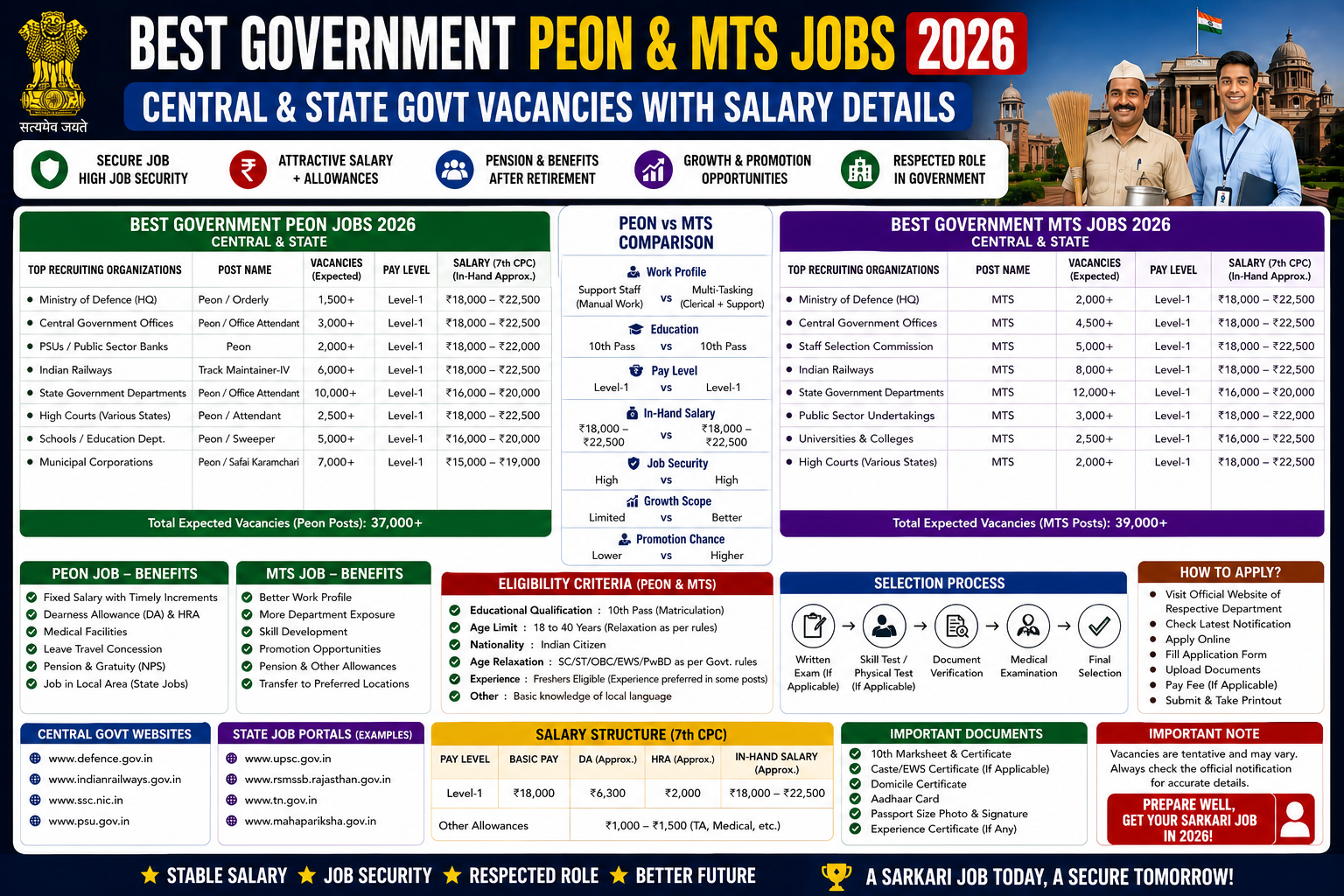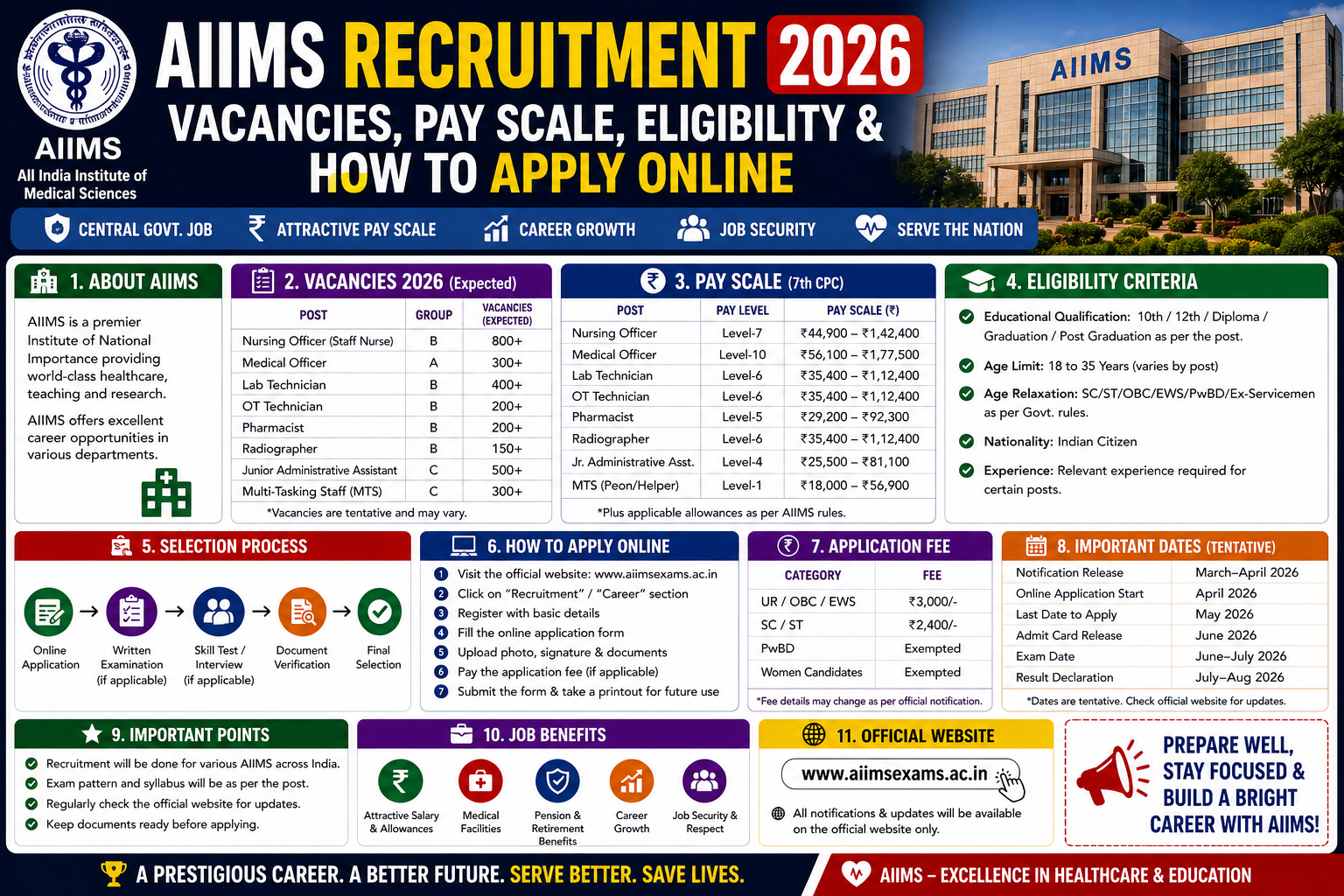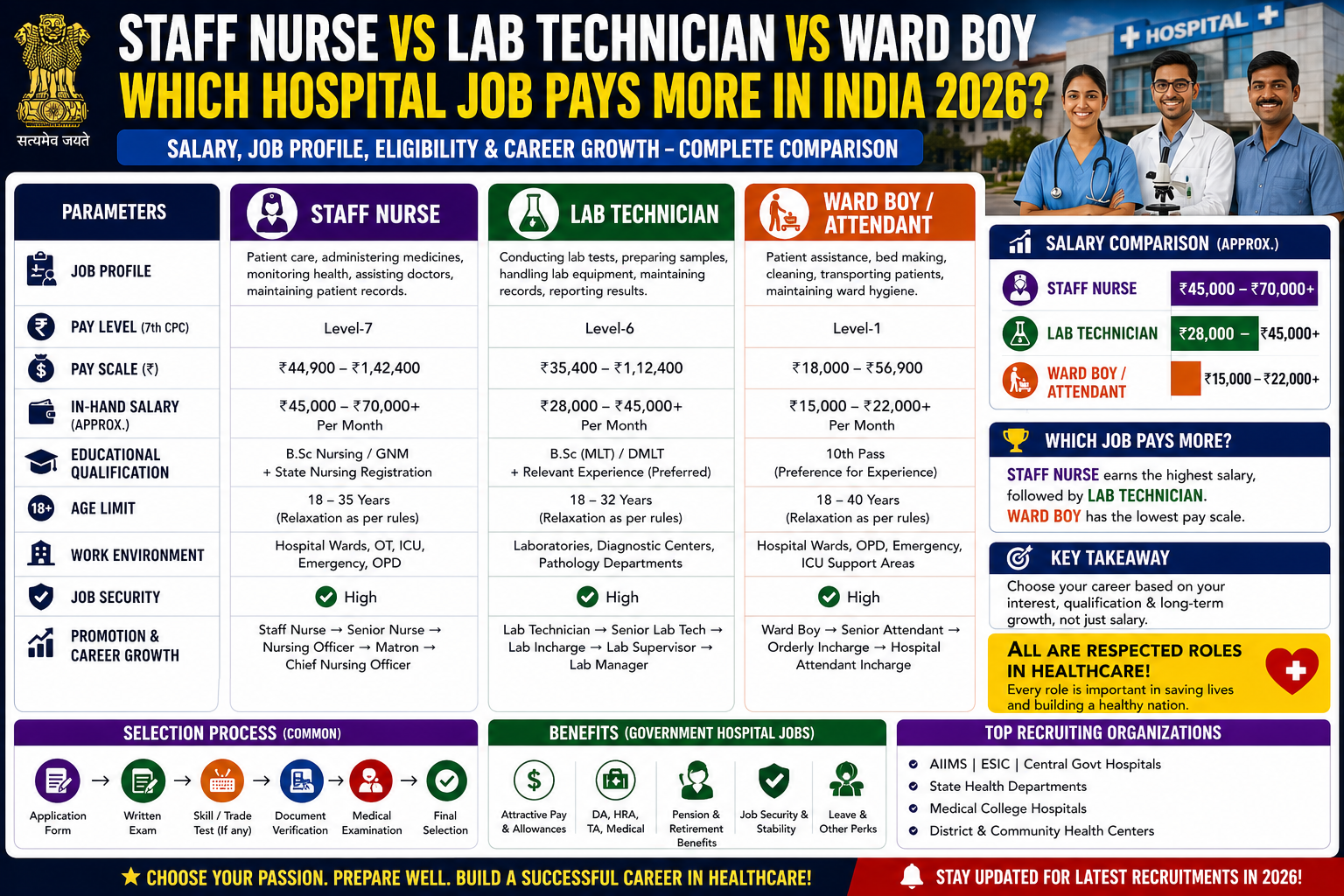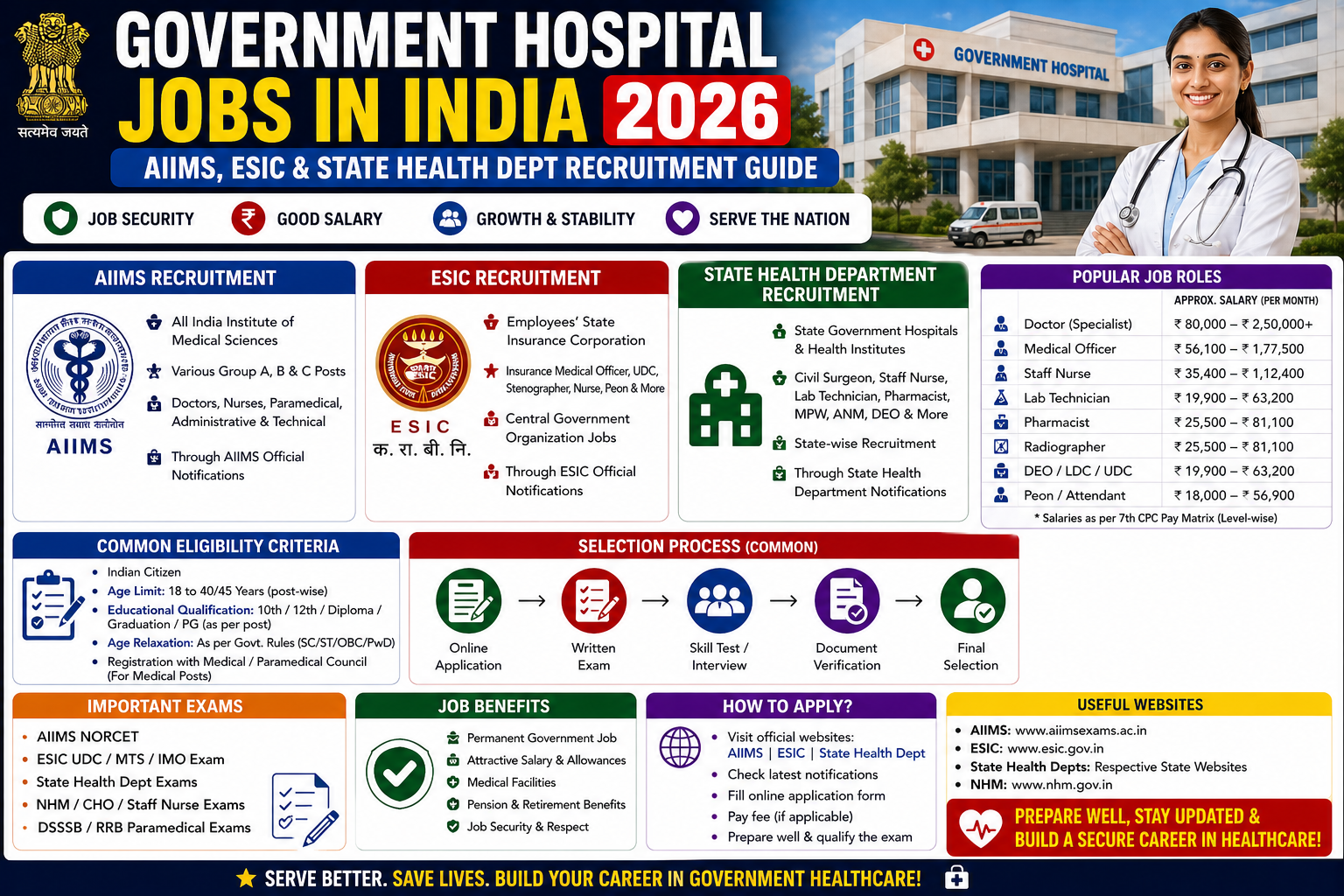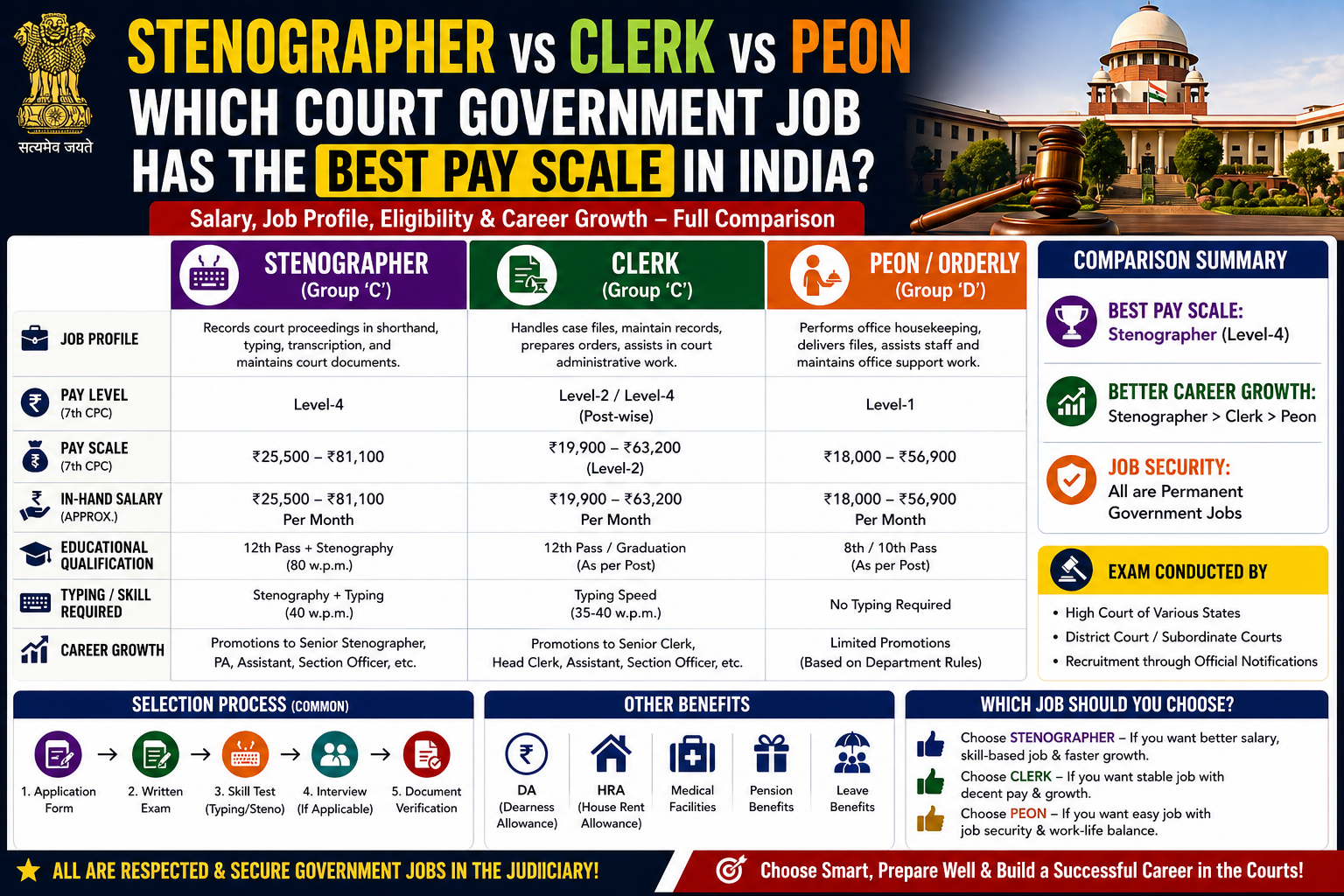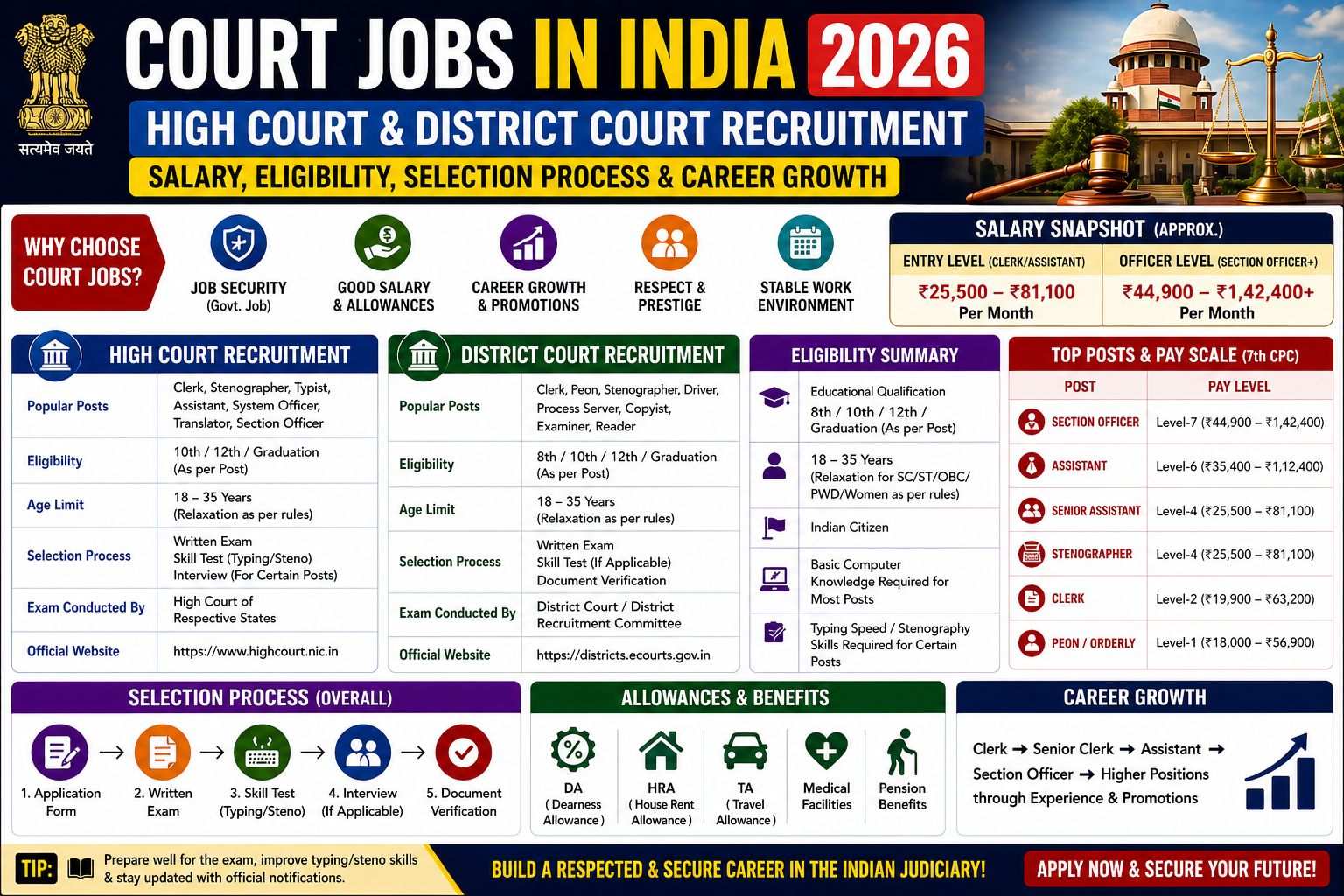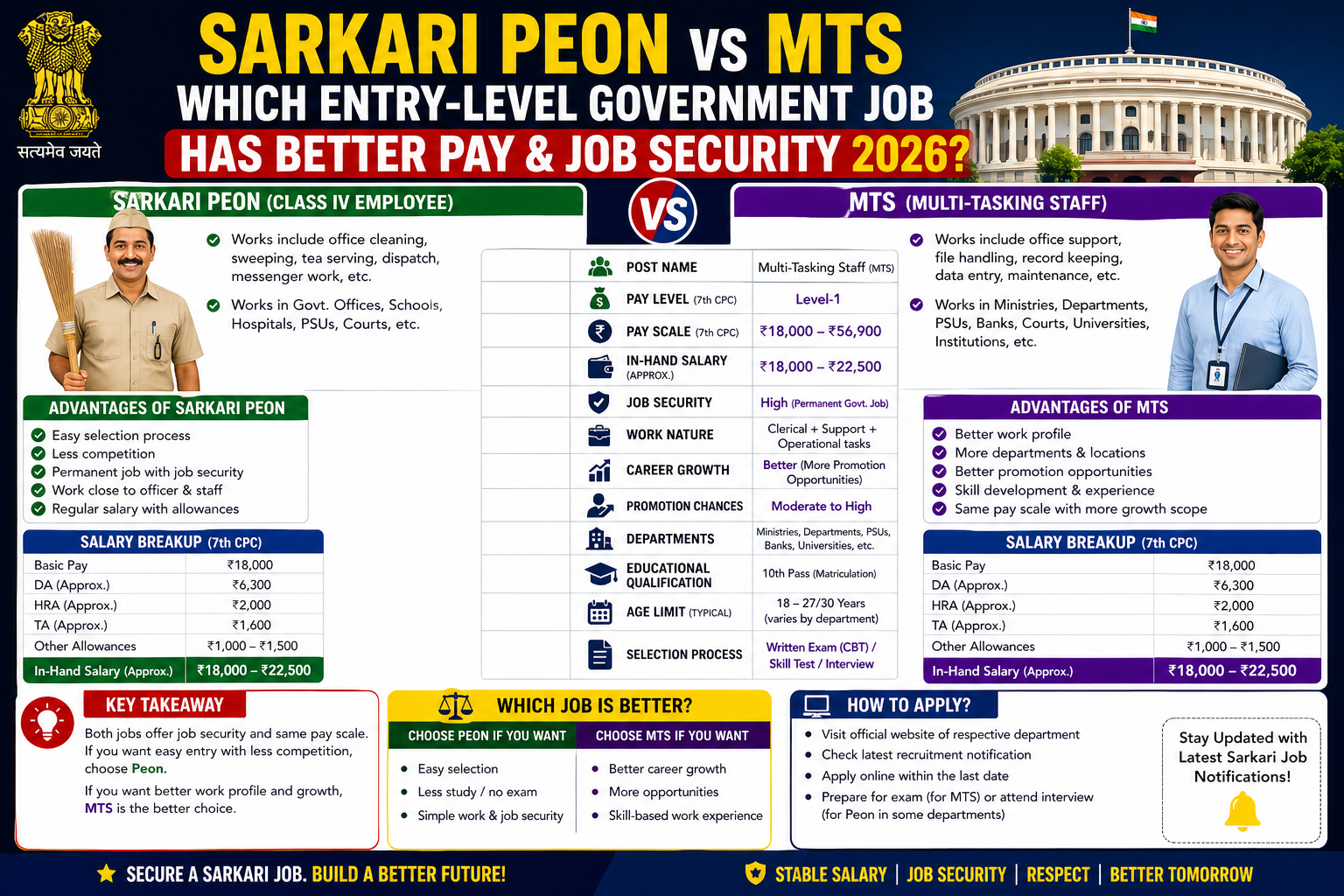
“Peon” and “MTS” sound like the same job. They are not. One is a central government permanent post under 7th Pay Commission. The other is a state government post with varying pay, rules, and security depending on the state. And then there are contractual peon posts — which are neither.
This comparison gives you the full picture in 2026 — salary, security, benefits, and which is the smarter career choice.
Understanding the Three Types First
Before comparing, you need to know what you are actually comparing:
| Type | Full Form | Employer | Pay Structure |
|---|---|---|---|
| Central Govt MTS | Multi-Tasking Staff (SSC MTS) | Central Ministries / Depts | 7th Pay Commission — Level 1 |
| State Govt Peon / Class IV | Peon / Attendant / Safaiwala | State Govt offices, schools, hospitals | State Pay Matrix (7th CPC equivalent) |
| Contractual Peon | Fixed-term / Daily wage support staff | Outsourced to private agencies | Contract-based — no government benefits |
This article compares Central MTS vs State Peon — both permanent government jobs. Contractual peon is not a government job and should be avoided as a career target.
Salary Comparison — Central MTS vs State Peon 2026
Central Government MTS (SSC MTS)
| Component | X City (Metro) | Y City | Z City / Rural |
|---|---|---|---|
| Basic Pay | ₹18,000 | ₹18,000 | ₹18,000 |
| DA (~50%) | ₹9,000 | ₹9,000 | ₹9,000 |
| HRA | ₹4,860 (27%) | ₹3,240 (18%) | ₹1,620 (9%) |
| Transport Allowance | ₹3,600 | ₹1,800 | ₹900 |
| Gross | ~₹35,000 | ~₹32,000 | ~₹28,000 |
| In-Hand | ~₹29,000–₹33,000 | ~₹26,000–₹29,000 | ~₹24,000–₹27,000 |
State Government Peon (Typical State)
| State | Basic Pay | In-Hand (Approx.) |
|---|---|---|
| Uttar Pradesh | ₹18,000–₹20,200 | ₹25,000–₹32,000 |
| Rajasthan | ₹17,000–₹19,900 | ₹23,000–₹30,000 |
| Bihar | ₹17,000–₹18,000 | ₹21,000–₹27,000 |
| Maharashtra | ₹18,000–₹21,700 | ₹26,000–₹33,000 |
| Karnataka | ₹17,000–₹20,500 | ₹24,000–₹31,000 |
| Haryana | ₹18,000–₹21,700 | ₹26,000–₹33,000 |
Salary verdict: Central MTS pays ₹2,000–₹6,000 more per month than most state peon posts at the same city classification — because of higher HRA rates and better transport allowance from central government norms.
Benefits Comparison — Where the Real Difference Lies
| Benefit | Central Govt MTS | State Govt Peon |
|---|---|---|
| Medical | CGHS — cashless, 300+ hospitals, all India | State health scheme (varies — some states have CGHS equivalent, many don’t) |
| Pension | NPS — employer contributes 14% of basic + DA | NPS (most states) — employer contributes 10–14% |
| LTC | Biennial — anywhere in India | State LTC — usually within state only |
| Transfers | Within department / all India | Within state |
| HRA Rates | Central rates (9–27%) — higher | State rates (varies — often 8–24%) |
| CSD / Canteen | Available in many central offices | Rarely available |
| Job Stability | Highest — central govt, no state politics | High — but state budget cycles affect salaries |
| Salary Delays | Virtually never | Occasional delays in some states (Bihar, UP history of delays) |
Benefits verdict: Central MTS wins clearly — especially CGHS medical. A family of four at CGHS saves ₹8,000–₹15,000/month compared to buying private health insurance.
Job Security Comparison
This is the most important factor for most candidates — and the answer is nuanced.
Central MTS Security
- Cannot be retrenched — permanent central government post
- Governed by Central Civil Services (CCS) rules — strongest job protection in India
- Salary comes from the Consolidated Fund of India — never delayed
- Even if the ministry restructures, you are transferred, not terminated
- Verdict: Maximum job security possible in India
State Peon Security
- Also permanent — state government service rules apply
- Generally very secure — but depends on state financial health
- Some states (particularly smaller/poorer states) have historically delayed DA revisions and increments
- State-level political changes occasionally affect transfers and promotions
- Verdict: Very high security — slightly below central government
Contractual Peon (Avoid)
- No job security — contract ends, job ends
- No pension, no CGHS, no NPS
- Often paid below minimum wage in some states
- Verdict: Not a career — avoid
Career Growth Comparison
| Path | Central MTS | State Peon |
|---|---|---|
| First Promotion | LDC (Level 2) via departmental exam | Junior Clerk / equivalent in state |
| Timeline | 5–8 years (merit + vacancy based) | 6–10 years (varies by state) |
| Senior Level | UDC (Level 4) → Assistant (Level 6) | UDC equivalent → Section level |
| Promotion Exam | Internal departmental exam (same as SSC CHSL level) | State internal exam |
| Transfer Risk | All India transfers possible | Within state — home district often possible |
Growth verdict: Both have similar promotion structures. Central MTS has a clearer, rule-bound promotion pathway under CCS rules. State peons sometimes face vacancy freezes that delay promotions in states with large bureaucratic backlogs.
The Home State Advantage — When State Peon Wins
Central MTS is better on salary, benefits, and security — but there is one major reason to choose state peon: you stay near home.
Central MTS employees can be posted anywhere in India based on ministry requirement. A candidate from Bihar might end up posted in Mumbai or Chandigarh. A state peon in Bihar stays in Bihar — often in their home district.
For candidates with family obligations, elderly parents, or strong regional roots, home-state posting outweighs the ₹3,000–₹5,000/month salary advantage of central MTS.
Head-to-Head Verdict
| Category | Winner |
|---|---|
| Salary (same city) | Central MTS |
| Medical Benefits | Central MTS (CGHS is unbeatable) |
| Pension | Central MTS (14% vs ~10% employer NPS contribution) |
| Job Security | Central MTS |
| Home Posting | State Peon |
| Easier to Get | State Peon (many states — merit on 10th marks, no exam) |
| Exam Required | SSC MTS exam for central |
| LTC | Central MTS (all India) |
| Transfer Risk | State Peon wins (stays in state) |
Which Should You Apply For?
Apply for BOTH simultaneously. There is no reason not to — they have different timelines, different portals, and different selection processes.
- Apply for SSC MTS 2026 (notification: 30 June 2026, ssc.gov.in) for central government post
- Apply for your state’s Class IV / Peon recruitment as it comes up (check state employment portal + district collectorate websites)
- Apply for district court peon (ecourts.gov.in) — very low competition, permanent state government post
The smartest candidates do not choose between central and state — they apply to every permanent government peon/MTS vacancy that opens and accept whichever comes first.
Final Word
Between Central MTS and State Peon, Central MTS is objectively better — higher salary, CGHS medical, stronger job security, and better pension. The only genuine argument for state peon is home-state posting.
If you are willing to relocate: Central MTS — always.
If staying near family matters more than ₹5,000 extra per month: State Peon.
If you want the fastest entry into government service: State Peon (no exam in many states — just 10th marks merit list).
Both are permanent, dignified government careers — and both are infinitely better than any contractual peon arrangement.
Preparing for SSC MTS 2026? Practice Reasoning, Maths, English, and GK free on PadhLe Buddy. Start today!