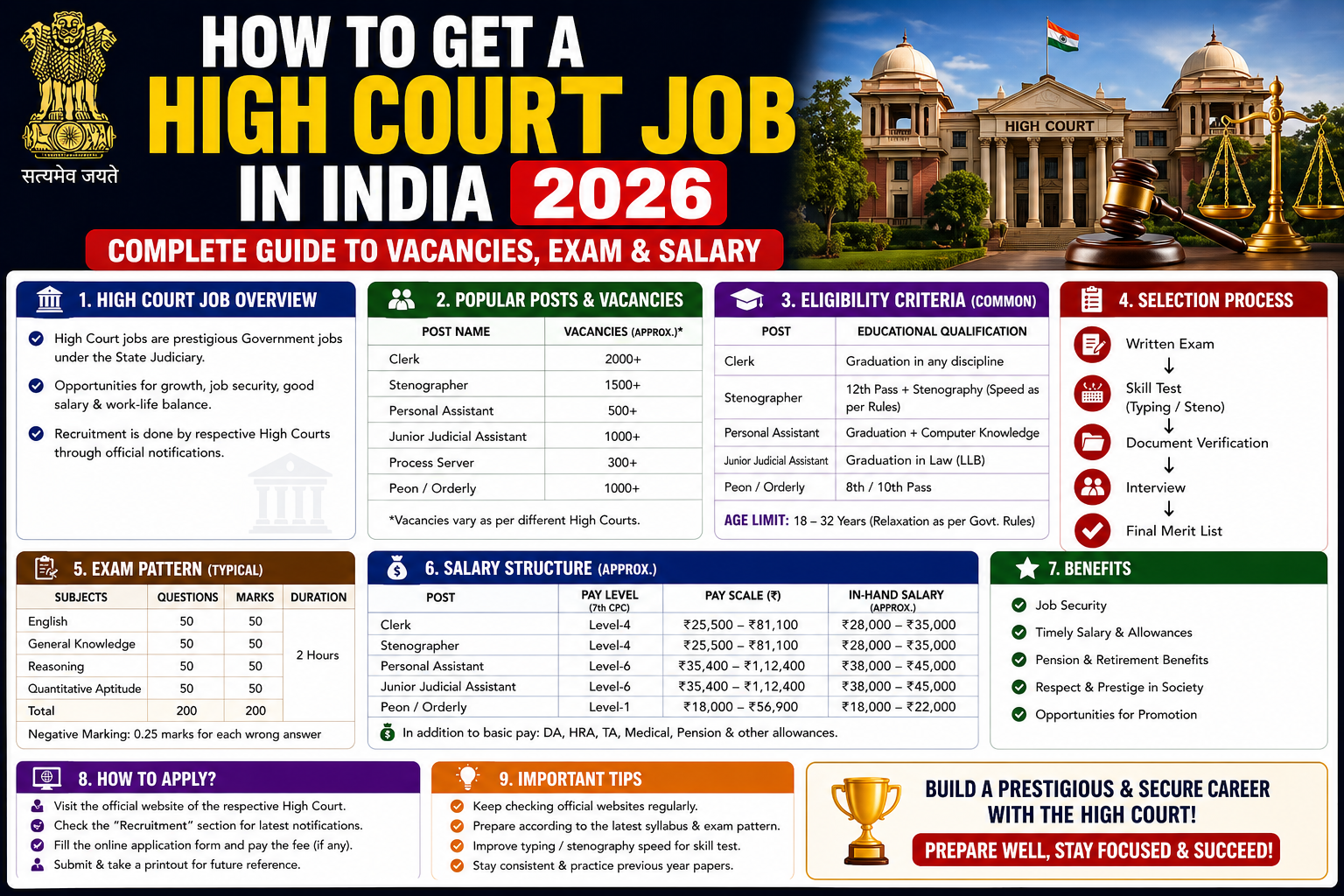
India has 25 High Courts — each independently recruiting staff for hundreds of posts every year. Unlike SSC or banking exams, there is no single national gateway. Every High Court runs its own recruitment, its own exam, and its own selection process. This makes tracking difficult — but it also means far lower competition than any central government exam.
Here is the exact roadmap to crack a High Court job in 2026.
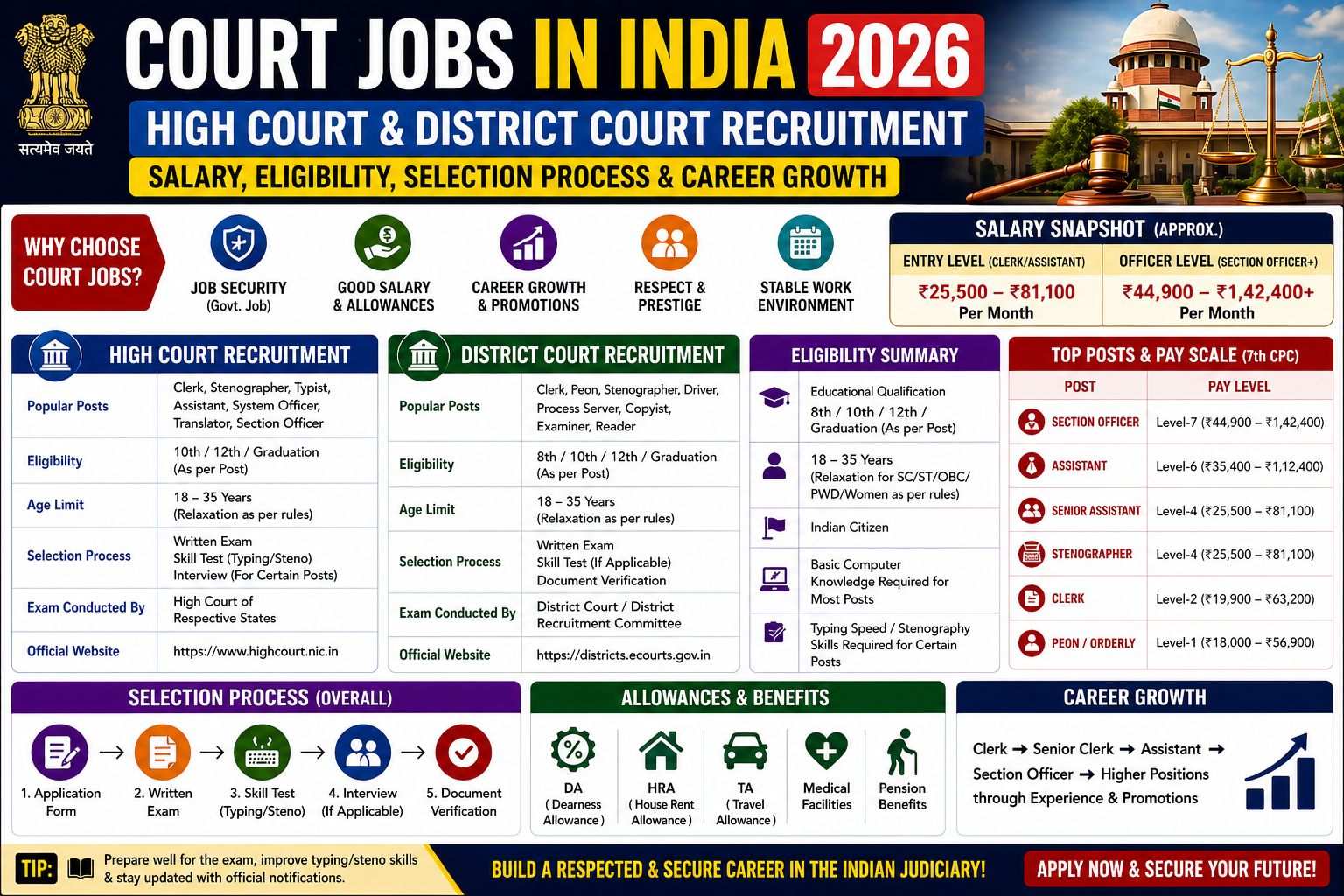
Step 1 — Know Which Posts Are Available
Every High Court hires across three categories:
| Category | Posts | Qualification |
|---|---|---|
| Group C — Technical | Stenographer (Higher & Lower Grade), Court Stenographer | 12th/Graduation + Shorthand |
| Group C — Clerical | Clerk, Copyist, Typist, Record Keeper | 12th Pass / Graduation + Typing |
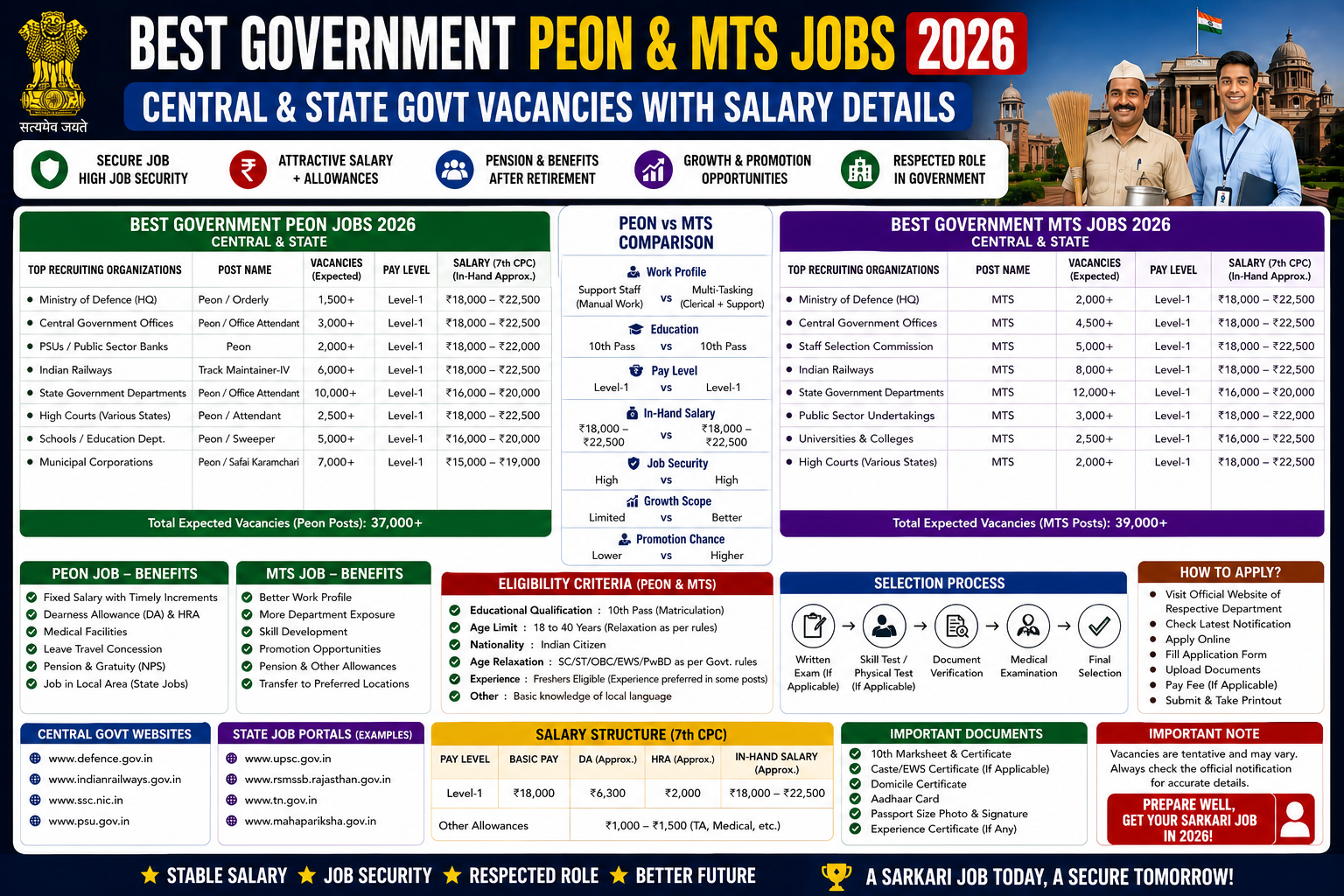
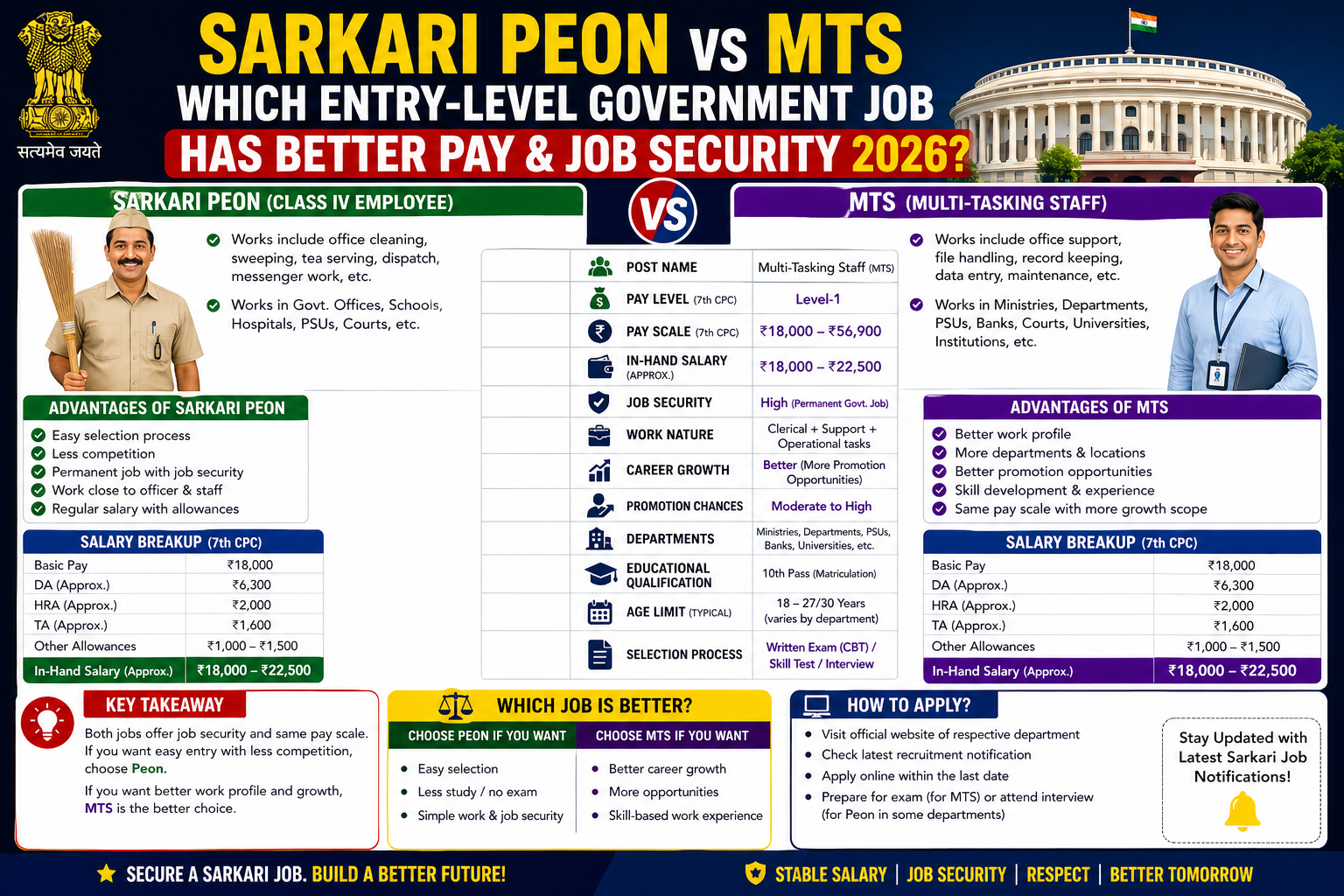
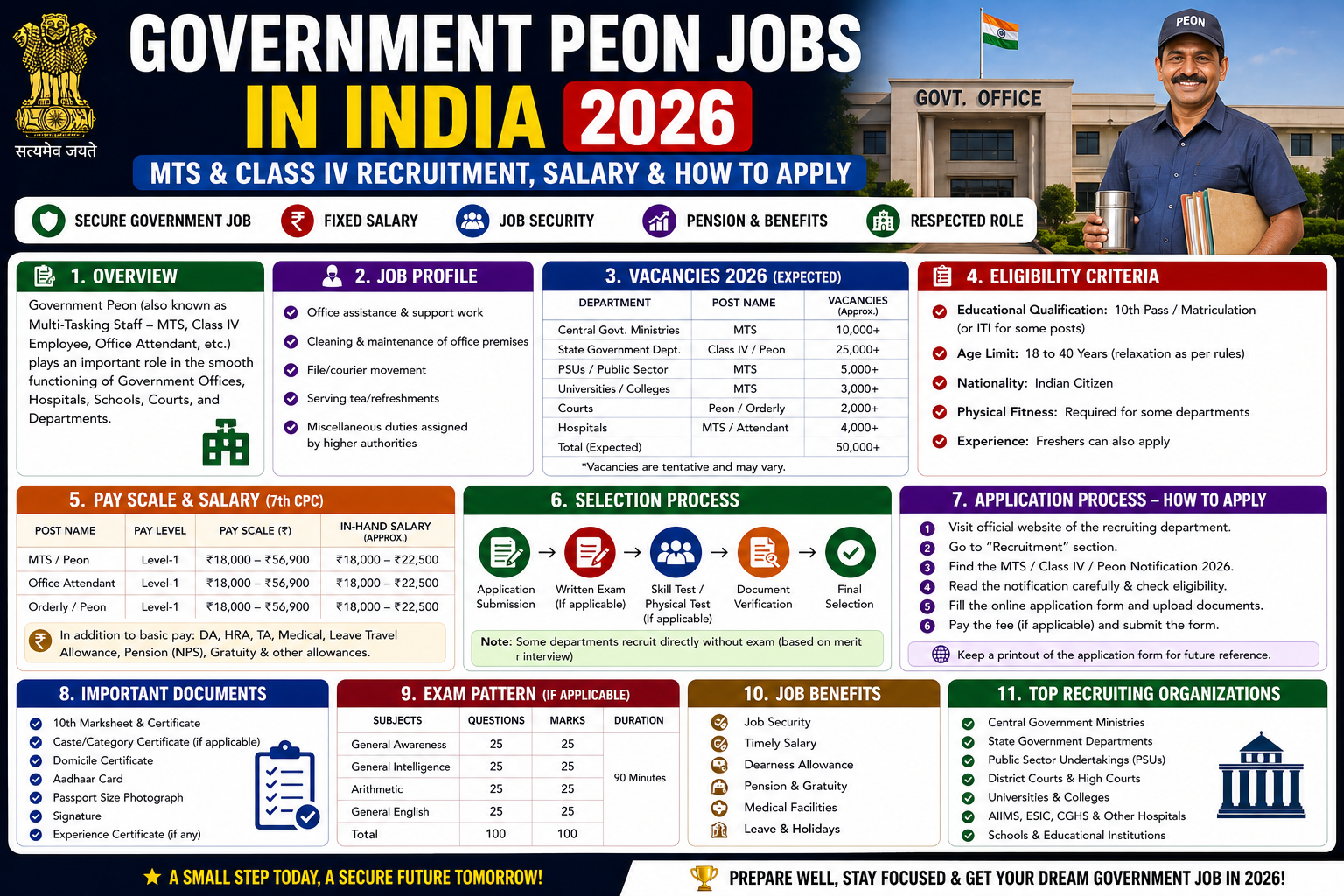
| Group D — Support | Peon, Hamal, Farash, Driver, Chowkidar | 7th–10th Pass |
| Law Clerk (Special) | Research Assistant to Judges | LLB (good academic record) |
| Non-Teaching Admin | Accountant, IT Assistant, Librarian | Degree/Diploma in relevant field |
The highest-volume posts across all High Courts are Clerk and Stenographer — these are where the maximum vacancies and the best career growth potential exist.
Step 2 — Know the Salary Before You Apply
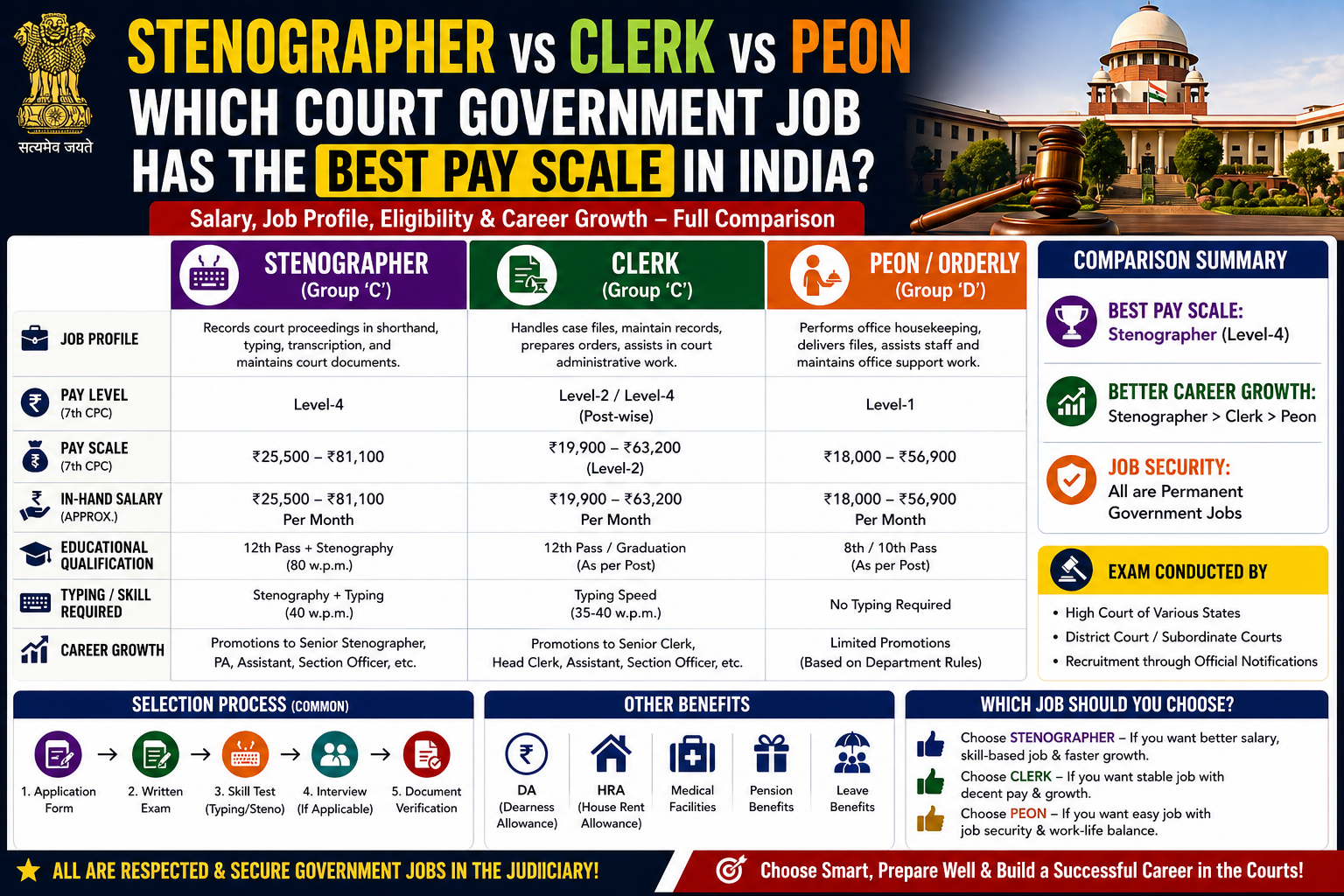
High Court salaries follow the state’s pay matrix (7th CPC equivalent). They vary slightly by state but the broad picture is consistent:
| Post | Pay Scale Range | In-Hand (Approx.) |
|---|---|---|
| Peon / Hamal / Farash | ₹16,600–₹52,500 | ₹25,000–₹35,000 |
| Driver | ₹21,700–₹69,100 | ₹33,000–₹50,000 |
| Typist / Copyist / Clerk (LDC) | ₹21,700–₹69,100 | ₹33,000–₹52,000 |
| Clerk (UDC equivalent) | ₹29,200–₹92,300 | ₹42,000–₹58,000 |
| Stenographer (Lower Grade) | ₹35,400–₹1,12,400 | ₹52,000–₹75,000 |
| Stenographer (Higher Grade) | ₹56,100–₹1,77,500 | ₹80,000–₹1,05,000 |
| Law Clerk / Junior Court Asst | Special stipend | ₹30,000–₹55,000 (fixed term) |
Bombay High Court benchmark (2026): Stenographer Lower Grade: ₹49,100–₹1,55,800 | Stenographer Higher Grade: ₹56,100–₹1,77,500 — among the highest steno pay scales in any Indian court.
Step 3 — Check Eligibility for Your Target Post
| Post | Education | Age | Skill |
|---|---|---|---|
| Peon | 7th–10th Pass | 18–35 | None |
| Clerk / Typist | 12th Pass | 18–35 | Typing 30–40 WPM |
| Stenographer (LG) | 12th Pass | 18–35 | Shorthand 80 WPM + Typing 40 WPM |
| Stenographer (HG) | Graduation | 18–38 | Shorthand 100–120 WPM + Typing 40–50 WPM |
| Law Clerk | LLB (50%+) | 21–26 | Strong academics + legal knowledge |
| IT / System Assistant | BCA / B.Tech CS-IT | 18–35 | Technical proficiency |
Age relaxation: SC/ST +5 years | OBC +3 years | PwD +10 years | Govt employees often get additional relaxation.
Language requirement: Most state High Courts require proficiency in the state’s official language — Marathi for Bombay HC, Kannada for Karnataka HC, Hindi for Allahabad HC, Tamil for Madras HC. This is strictly tested in the written exam and skill test.
Step 4 — Understand the Selection Process
High Court recruitment typically has 3–4 stages:
Stage 1 — Written Exam (CBT or OMR)
| Section | Topics | Marks |
|---|---|---|
| English Language | Grammar, Comprehension, Vocabulary | 25–40 |
| General Knowledge | Current Affairs, Constitution, Legal Awareness | 25–40 |
| Reasoning Ability | Analogy, Series, Coding, Syllogism | 20–30 |
| Quantitative Aptitude | Basic Maths, DI | 15–25 |
| Regional Language | Grammar + Comprehension (state language) | 20–30 |
No negative marking in many High Courts (verify from each notification). Duration: 90–120 minutes.
Stage 2 — Skill Test
- Clerk: Typing test — 30–40 WPM in English and/or regional language
- Stenographer: Shorthand dictation (80–120 WPM) + Transcription accuracy test
- Peon: No skill test (merit + interview only)
Skill tests are qualifying — you must pass but marks may or may not count toward final merit depending on the court.
Stage 3 — Document Verification
Original certificates: Education, age proof, caste certificate (if applicable), local/domicile certificate (many High Courts require state domicile), language proficiency certificate.
Stage 4 — Final Merit List
Most High Courts prepare the final merit list based entirely on written exam marks (skill test is qualifying). Some courts add interview marks (5–15%) for steno posts. There is no personality test or SSB for court jobs.
Step 5 — Apply at the Right Portal
There is no single portal — each High Court has its own:
| High Court | Official Website |
|---|---|
| Allahabad (UP) | allahabadhighcourt.in |
| Bombay (Maharashtra, Goa) | bombayhighcourt.nic.in |
| Delhi | delhihighcourt.nic.in |
| Madras (Tamil Nadu) | hcmadras.tn.gov.in |
| Karnataka | karnatakahighcourt.kar.nic.in |
| Kerala | hckerala.nic.in |
| Rajasthan | hcraj.nic.in |
| MP | mphc.gov.in |
| Punjab & Haryana | highcourtchd.gov.in |
| Gujarat | gujarathighcourt.nic.in |
| Calcutta | calcuttahighcourt.gov.in |
| Hyderabad / Telangana | hcap.nic.in |
Application fee: ₹200–₹1,000 depending on post and court | SC/ST/PwD often exempt or reduced.
Step 6 — Prepare Smart
For Clerk posts: Focus 40% time on typing speed (minimum 40 WPM before applying), 60% on written exam. High Court written exams are not very hard — Standard 12th level aptitude + GK + state language.
For Stenographer posts: Shorthand is the decider. Start Pitman shorthand training immediately. Written exam is similar to clerk level — focus on language and GK.
Legal GK topics that appear frequently:
- Indian Constitution — Part III (Fundamental Rights), Judiciary chapter
- High Court’s powers under Article 226 (Writ jurisdiction)
- Difference between Sessions Court, High Court, Supreme Court
- Basic legal terms — bail, habeas corpus, contempt, affidavit, ex parte, stay order
- Chief Justice of India, current CJI, recent Supreme Court judgements
English section: Reading comprehension, error spotting, fill in the blanks, synonyms/antonyms — all standard. Read one English editorial daily.
How Frequently Do High Courts Recruit?
Most major High Courts release recruitment notifications 1–2 times per year. Some years see larger batches when vacancies accumulate. The Bombay High Court 2025–26 cycle had 2,381 vacancies — one of the largest in recent years.
Never miss a notification strategy:
- Bookmark your state High Court’s official website
- Check it every Monday without fail
- Follow the court’s official Twitter/X handle
- Set a Google Alert: “[Your state] High Court recruitment 2026”
High Court notifications open and close in 3–5 weeks — missing the window means waiting another year.
Final Word
Getting a High Court job in India in 2026 comes down to three things: knowing which court in your state is hiring, having the typing or shorthand skill ready before the notification drops, and clearing a moderately-difficult written exam.
The salary is excellent (Stenographer Higher Grade: ₹80,000–₹1,05,000/month), the job security is among the strongest in government service (judiciary is constitutionally insulated), and the work culture — court hours, structured environment, limited field work — offers some of the best work-life balance of any government job.
Start tracking your state’s High Court website today. The next notification could drop any week.
Preparing for High Court exams? Practice English, Legal GK, Reasoning, and Regional Language on PadhLe Buddy free topic-wise. Start today!