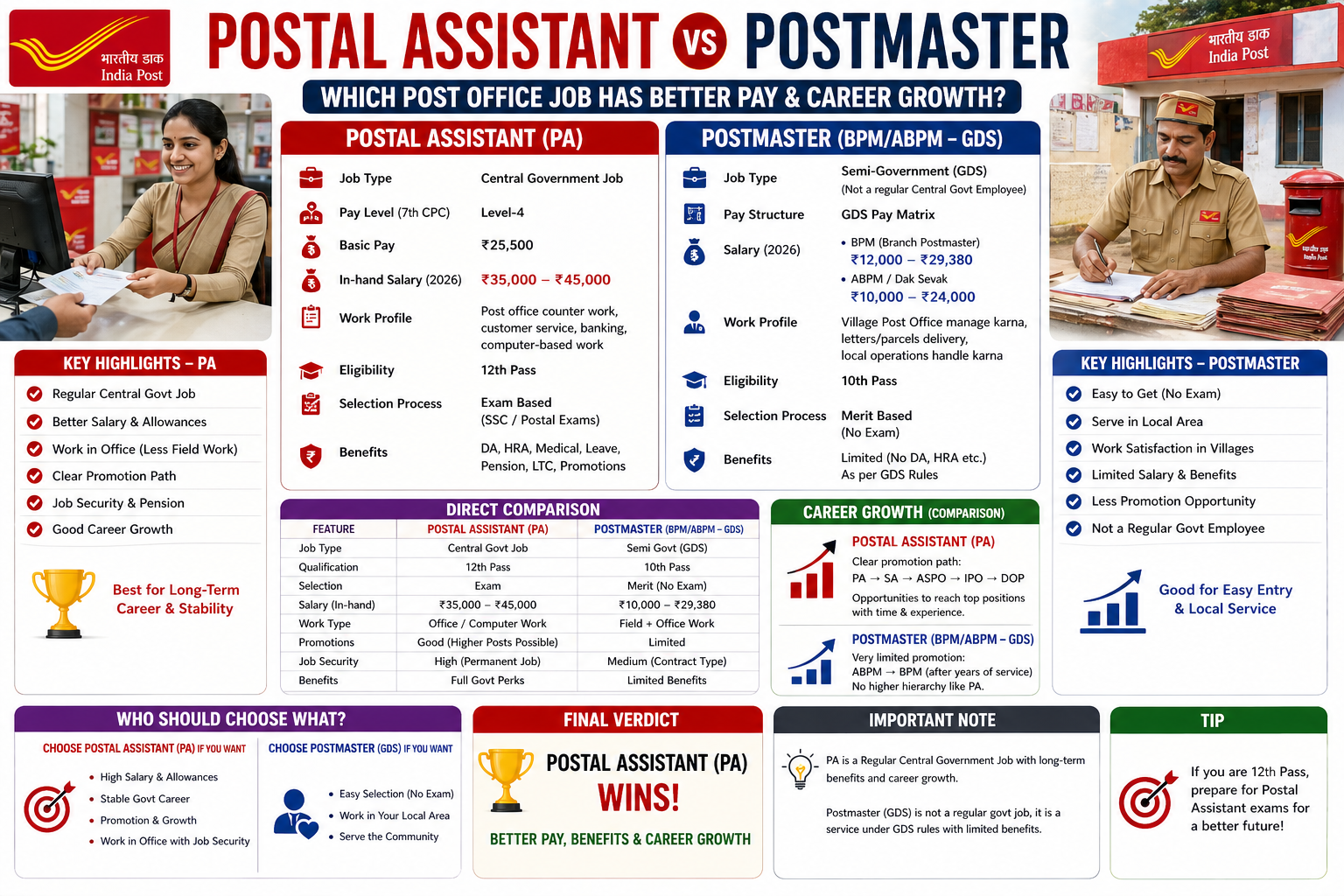
India Post — the Department of Posts, Government of India — is the world’s largest postal network with over 1.5 lakh post offices and approximately 4 lakh employees. Among all the recruitment opportunities in India Post, two posts generate the most confusion among aspirants: Postal Assistant (PA) and Postmaster.
Both work within post offices. Both deal with postal operations. Both are government employees. Yet they enter through different exams, sit at very different salary levels, and offer completely different career trajectories.
This detailed comparison breaks down the Postal Assistant vs Postmaster question in full — covering pay scale, in-hand salary, eligibility, exam route, job profile, and career growth path — so you can make the right decision about which India Post career to target in 2026.
Understanding the India Post Employee Hierarchy First
Before comparing specific posts, understanding the overall India Post hierarchy is essential — because Postal Assistant and Postmaster are not the same level of post, and understanding the ladder clarifies why their salaries differ.
| Level | Post | Pay Level | Entry Route |
|---|---|---|---|
| Group D | Multi-Tasking Staff (MTS), Peon | Level 1 | SSC MTS |
| Group C — Entry | Postman / Mail Guard | Level 3 | Departmental / SSC |
| Group C — Core | Postal Assistant / Sorting Assistant (PA/SA) | Level 4 | SSC CHSL |
| Group C — Supervisor | LSG (Lower Selection Grade) Deputy Postmaster | Level 5–6 | Promotion from PA |
| Group C — Sr. Supervisor | HSG-II Sub-Postmaster | Level 6 | Promotion |
| Group C — Postmaster | Postmaster Grade I / HSG-I Postmaster | Level 7 | SSC CGL / Promotion |
| Group B | Inspector of Posts / ASPO | Level 7–8 | SSC CGL / Promotion from PA |
| Group A | Senior Superintendent / IPoS Officer | Level 10+ | UPSC (IPoS) |
The key insight from this table: Postal Assistant (PA) is a Level 4 entry-level post, while Postmaster Grade I (HSG-I) is a Level 7 supervisor post. These are not equivalent — they sit three pay levels apart, with the Postmaster significantly higher in both salary and responsibility.
What Is a Postal Assistant?
The Postal Assistant (PA) — officially renamed Customer Service Executive in some circles — is the most common entry-level clerical post in India Post, recruited primarily through the SSC CHSL (Staff Selection Commission Combined Higher Secondary Level) examination. PAs are posted in Head Post Offices, Sub-Post Offices, Circle Offices, Savings Bank Control Organizations, and Mail Motor Service units.
Postal Assistant Job Profile
A PA’s work is primarily counter and back-office based:
- Receiving and registering mails, speed posts, and registered letters at the counter
- Handling customer queries on postal savings, insurance, and banking services
- Managing India Post Payments Bank (IPPB) transactions at post office branches
- Processing money orders, direct benefit transfer disbursements
- Maintaining accounts, updating ledgers, and database entry
- Accepting deposits under Post Office Savings Schemes (NSC, KVP, PPF, Sukanya Samriddhi)
- Booking and tracking parcels, speed post, and Express Mail Service (EMS) shipments
- Back-office processing: sorting, bundling, and dispatching mail to delivery units
PAs work standard government office hours — typically 9 AM to 5:30 PM — with Saturday half-day in most offices. This makes PA one of the most balanced work-life government jobs available.
Postal Assistant Salary 2026
Postal Assistants are placed at Pay Matrix Level 4 under the 7th Pay Commission.
| Component | Amount |
|---|---|
| Basic Pay (Level 4, starting) | ₹25,500/month |
| Dearness Allowance (DA ~50%) | ~₹12,750 |
| HRA — X City (27%) | ₹6,885 |
| HRA — Y City (18%) | ₹4,590 |
| HRA — Z City (9%) | ₹2,295 |
| Transport Allowance | ₹1,350–₹3,600 |
| Gross Salary (X City) | ~₹48,000–₹52,000/month |
| Deductions (NPS 10%, CGHS, tax) | ~₹4,000–₹7,000 |
| In-Hand Salary (X City) | ~₹42,000–₹48,000/month |
| In-Hand Salary (Y City) | ~₹38,000–₹44,000/month |
| In-Hand Salary (Z City/Rural) | ~₹33,000–₹38,000/month |
Pay Scale progression: ₹25,500 – ₹81,100 (Level 4, over full career)
What Is a Postmaster?
The term “Postmaster” in India Post refers to multiple grades of supervisory posts who manage post offices at various levels — from managing a small Sub Post Office to heading a major Head Post Office. There are primarily three grades of Postmasters in the regular postal hierarchy:
| Grade | Full Name | Pay Level | Who They Manage |
|---|---|---|---|
| LSG | Deputy PM / Lower Selection Grade | Level 5–6 | Small Sub-Post Office |
| HSG-II | Sub Postmaster / Higher Selection Grade II | Level 6 | Sub Post Office |
| HSG-I | Postmaster Grade I / Head Post Office Postmaster | Level 7 | Head Post Office |
For this comparison, we focus primarily on the HSG-I Postmaster (Postmaster Grade I) — the most commonly referenced “Postmaster” post — which is both the highest postmaster grade within Group C and the most prestigious non-officer post in India Post field operations.
Postmaster Job Profile
A Postmaster (especially HSG-I) manages a complete post office unit:
- Overall administration and management of the post office
- Supervision of all PAs, Sorting Assistants, Postmen, and MTS staff
- Financial management — maintaining cash balance, reconciling accounts, reporting discrepancies
- Customer relations — resolving escalated complaints, managing VIP/sensitive cases
- Ensuring compliance with India Post operational rules and procedures
- Managing India Post Payments Bank operations at the office level
- Target management — achieving business targets for savings accounts, insurance, PLI, IPPB
- Representing the post office in official communications and inspections
A Postmaster holds real administrative authority and accountability — the buck stops at the Postmaster’s desk. This is a management role, not a counter role.
How to Become a Postmaster
There are two routes to becoming a Postmaster in India Post:
Route 1 — SSC CGL (Direct Entry at Grade B / Inspector Level → Promotion to HSG-I): The SSC CGL exam recruits Inspectors of Posts (IPs) at Pay Level 7 — who typically reach the Postmaster Grade-I equivalent level faster through administrative postings.
Route 2 — Promotion from Postal Assistant (Most Common Path): The majority of Postmasters in India Post are promoted PAs who have risen through the departmental promotion ladder:
PA → LSG (Deputy PM) → HSG-II (Sub-Postmaster) → HSG-I (Postmaster Grade I)
Each promotion requires satisfactory service, seniority, and qualifying departmental exams (Postmaster Grade I exam for the final promotion).
Postmaster Salary 2026
HSG-I Postmaster (Postmaster Grade I)
| Component | Amount |
|---|---|
| Basic Pay (Level 7, starting) | ₹44,900/month |
| Dearness Allowance (~50%) | ~₹22,450 |
| HRA — X City (27%) | ₹12,123 |
| HRA — Y City (18%) | ₹8,082 |
| HRA — Z City (9%) | ₹4,041 |
| Transport Allowance | ₹2,250–₹5,400 |
| Gross Salary (X City) | ~₹83,000–₹87,000/month |
| Deductions (NPS, CGHS, tax) | ~₹8,000–₹12,000 |
| In-Hand Salary (X City) | ~₹72,000–₹80,000/month |
| In-Hand Salary (Y City) | ~₹65,000–₹72,000/month |
| In-Hand Salary (Z City) | ~₹57,000–₹65,000/month |
Pay Scale: ₹44,900 – ₹1,42,400 (Level 7, same as Inspector of Posts)
HSG-II Sub-Postmaster (Intermediate Grade)
| Component | Amount |
|---|---|
| Basic Pay (Level 6) | ₹35,400/month |
| In-Hand Salary (X City) | ~₹58,000–₹65,000/month |
| In-Hand Salary (Y City) | ~₹52,000–₹58,000/month |
LSG Deputy Postmaster (Junior Grade)
| Component | Amount |
|---|---|
| Basic Pay (Level 5–6) | ₹29,200–₹35,400/month |
| In-Hand Salary (X City) | ~₹48,000–₹58,000/month |
Side-by-Side Salary Comparison
| Parameter | Postal Assistant (PA) | HSG-I Postmaster (PMG-I) |
|---|---|---|
| Pay Level | Level 4 | Level 7 |
| Starting Basic Pay | ₹25,500/month | ₹44,900/month |
| Gross Salary (Metro) | ₹48,000–₹52,000 | ₹83,000–₹87,000 |
| In-Hand (X City) | ₹42,000–₹48,000 | ₹72,000–₹80,000 |
| In-Hand (Y City) | ₹38,000–₹44,000 | ₹65,000–₹72,000 |
| In-Hand (Z City) | ₹33,000–₹38,000 | ₹57,000–₹65,000 |
| Annual CTC | ~₹5.8–₹6.5 Lakh | ~₹10.5–₹11.5 Lakh |
| Pay Scale Ceiling | ₹81,100 | ₹1,42,400 |
Postmaster (HSG-I) earns ₹28,000–₹32,000 more per month in-hand than a fresh Postal Assistant in the same city. Over a year, this is a difference of ₹3.4–₹3.8 lakh in annual earnings. The difference reflects both the higher Pay Level and the higher HRA on a larger basic pay.
Eligibility & Exam Comparison
| Factor | Postal Assistant | Postmaster (HSG-I via Promotion) | Postmaster (via SSC CGL IP) |
|---|---|---|---|
| Minimum Education | 10+2 (Intermediate) | Already employed as PA | Any graduation |
| Exam | SSC CHSL | Departmental exam (Postmaster Grade I exam) | SSC CGL |
| Entry Age | 18–27 years | No fresh entry; promotion only | 18–30 years |
| Work Experience Needed | None | 10–15 years as PA/LSG | 5 years as Inspector → various promotions |
| Exam Conducting Body | Staff Selection Commission (SSC) | Department of Posts (internal) | Staff Selection Commission (SSC) |
Critical insight: You cannot become an HSG-I Postmaster directly — there is no fresh external recruitment for this grade. All HSG-I Postmasters are either:
- PAs who have been promoted through the departmental ladder (most common)
- SSC CGL Inspectors of Posts (Level 7) who are posted as Postmasters in Head Post Offices
Career Growth Path — Where Each Post Leads
Postal Assistant → Career Ladder
PA → LSG (Deputy PM) → HSG-II (Sub-PM) → HSG-I (Postmaster Grade I / Inspector of Posts) → ASPO (Assistant Superintendent Posts) → SPO (Superintendent Posts) → SSPO (Sr. Superintendent)
Alternative branch: PA → PA-SA (Sorting Assistant) → IPO (Inspector of Posts) via departmental exam after 5 years → Group B Gazetted Officer
| Timeline | Post | Pay Level | In-Hand (Metro) |
|---|---|---|---|
| Joining | Postal Assistant | Level 4 | ₹42,000–₹48,000 |
| 5–8 years | LSG (Deputy PM) | Level 5–6 | ₹48,000–₹58,000 |
| 10–12 years | HSG-II (Sub-Postmaster) | Level 6 | ₹58,000–₹65,000 |
| 15–20 years | HSG-I (Postmaster Grade I) | Level 7 | ₹72,000–₹80,000 |
| 20–22 years | Inspector of Posts (IPO via LDCE) | Level 7–8 | ₹75,000–₹90,000 |
| 25+ years | ASPO / SPO | Level 8–10 | ₹85,000–₹1,10,000 |
Inspector of Posts → Career Ladder (SSC CGL Route)
Inspector of Posts → ASPO → SPO → SSPO → Postal Superintendent → Director → Chief PMG
| Timeline | Post | Pay Level | In-Hand (Metro) |
|---|---|---|---|
| Joining | Inspector of Posts | Level 7 | ₹65,000–₹75,000 |
| 5 years | ASPO | Level 8 | ₹75,000–₹88,000 |
| 10 years | SPO / Superintendent | Level 10 | ₹90,000–₹1,10,000 |
| 15–20 years | SSPO / Joint Director | Level 11–12 | ₹1,00,000–₹1,40,000 |
| 25+ years | Director / PMG | Level 13–14 | ₹1,40,000–₹2,00,000 |
Exam Pattern — SSC CHSL (Postal Assistant) vs SSC CGL (Inspector of Posts)
SSC CHSL 2026 — Postal Assistant
| Stage | Format | Marks |
|---|---|---|
| Tier 1 (CBE) | Objective MCQ — GK, English, Reasoning, Quantitative | 200 marks / 60 min |
| Tier 2 | Descriptive — Essay + Letter in English/Hindi | 100 marks / 60 min |
| Skill Test | Typing test (35 WPM English / 30 WPM Hindi) | Qualifying |
Eligibility: 10+2 (any stream) | Age: 18–27 years | SSC CHSL conducted by SSC annually
SSC CGL 2026 — Inspector of Posts
| Stage | Format | Marks |
|---|---|---|
| Tier 1 (CBE) | Objective MCQ — GK, English, Reasoning, Quantitative | 200 marks / 60 min |
| Tier 2 (CBE) | Paper I (Maths + Reasoning + English + GK) — 390 marks; Paper II (Statistics — optional); Paper III (Finance & Economics — optional) | 390–690 marks |
| Document Verification | Final stage | — |
Eligibility: Any graduation | Age: 18–30 years | SSC CGL is significantly harder than SSC CHSL — more competition, harder Tier 2 maths, and higher cutoffs.
Difficulty comparison: SSC CGL Inspector of Posts is approximately 3–4x harder than SSC CHSL Postal Assistant in terms of competition ratio and exam depth.
Work Profile Comparison — Day-to-Day Reality
| Aspect | Postal Assistant | Postmaster (HSG-I) |
|---|---|---|
| Primary Setting | Counter and back-office | Office management |
| People Interaction | High — customer-facing daily | Supervisory — staff and escalation management |
| Physical Demands | Desk job — low physical strain | Desk job with inspection duties |
| Decision Authority | Executes procedures | Takes administrative decisions |
| Accountability | Individual task completion | Entire post office operations |
| Work Hours | Fixed 9–5:30 | Fixed + additional responsibility for office outcomes |
| Transfers | Within state/circle (less frequent) | Within circle (more frequent at senior levels) |
| Pressure | Moderate — counter queues | Higher — financial targets, staff management, complaints |
| Prestige | Respected clerical government job | Respected supervisor/manager position |
IPoS Officer — The Highest Postal Career (UPSC Route)
For aspirants who want to reach the top of India Post’s hierarchy, the Indian Postal Service (IPoS) is the Group A All India Service recruited through UPSC. IPoS officers begin as Senior Superintendent of Post Offices (SSPO) and can rise to Chief Postmaster General (head of a state postal circle).
| Post | Pay Level | In-Hand Salary |
|---|---|---|
| IPoS Probationer | Level 10 | ₹80,000–₹1,00,000 |
| SSPO | Level 11–12 | ₹95,000–₹1,30,000 |
| PMG (Postmaster General) | Level 13–14 | ₹1,40,000–₹2,00,000 |
| Chief PMG | Apex Scale | ₹2,05,400–₹2,25,000 |
IPoS entry requires clearing UPSC — one of India’s toughest exams. Eligibility: Any graduation with science background (similar to IFoS).
Benefits — Both Posts Get Full Central Government Package
Regardless of whether you are a Postal Assistant or Postmaster, all regular India Post employees receive:
| Benefit | Details |
|---|---|
| CGHS Medical | Cashless treatment at CGHS empanelled hospitals for employee + family |
| NPS Pension | Employer contributes 14% of basic + DA |
| LTC | Biennial Leave Travel Concession for self + family |
| Children’s Education Allowance | ₹2,250/month per child (up to 2 children) |
| Uniform Allowance | For operational staff (Postman, Mail Guard); not for PA/PM desk posts |
| Earned Leave | 30 days per year |
| DCRG Gratuity | Maximum ₹20 lakh on retirement |
| Home Loan | India Post provides staff housing loan assistance |
| Annual Increment | 3% of basic pay per year |
Which Is Better — Postal Assistant or Postmaster?
| Consider PA if… | Consider Postmaster (via Inspector of Posts) if… |
|---|---|
| You have completed 10+2 (not graduation) | You have a graduation degree and want faster salary growth |
| You want a stable desk job with predictable hours | You want administrative authority and management responsibility |
| You prefer starting earlier in your career | You can invest in SSC CGL preparation |
| You are willing to grow through departmental promotions | You want to reach ASPO/SPO level faster than the departmental route allows |
| You want home-state posting with minimal transfers | You are comfortable with transfers within a state circle |
Bottom line: If you have only 10+2, Postal Assistant via SSC CHSL is your primary India Post target — and through diligent departmental service and exams, you can eventually reach the Postmaster / Inspector level from within. If you are a graduate, targeting Inspector of Posts via SSC CGL gives you a Level 7 entry that typically takes a PA 15–20 years to reach. The SSC CGL route is harder but delivers significantly better starting salary and faster career progression.
For graduates, targeting both SSC CHSL (PA as backup) and SSC CGL (Inspector as primary) simultaneously is the smartest strategy — both share the same Tier 1 pattern, so preparation overlaps significantly.
FAQ — Postal Assistant vs Postmaster 2026
Q1. Can a Postal Assistant become a Postmaster? Yes — most HSG-I Postmasters in India are promoted PAs. The path is PA → LSG → HSG-II → HSG-I (Postmaster Grade I). Each step requires satisfactory service and qualifying a departmental exam. Timeline: typically 15–20 years.
Q2. Can I directly apply for Postmaster Grade I externally? No — there is no direct external recruitment for HSG-I Postmaster. The post is filled through internal departmental promotion. The nearest external entry to a similar salary level is the Inspector of Posts through SSC CGL.
Q3. What is the qualification for Postal Assistant in 2026? 10+2 (any stream) from a recognized board. Age: 18–27 years. Selected through SSC CHSL examination.
Q4. Which exam is harder — SSC CHSL (PA) or SSC CGL (Inspector of Posts)? SSC CGL is significantly harder — it requires graduation (vs 10+2), has more competitive candidates, and includes harder Tier 2 mathematics and reasoning. SSC CHSL is more accessible.
Q5. What is the maximum salary a Postal Assistant can earn in their career? A PA at the top of Level 4 (₹81,100 basic) in a metro city earns approximately ₹1,20,000–₹1,30,000/month in gross salary. However, most experienced PAs get promoted to LSG or HSG levels long before reaching the top of Level 4.
Final Word
The Postal Assistant and Postmaster are not competing options for the same candidate — they are different career entry points in the same organization.
If you are a 10+2 pass candidate, Postal Assistant via SSC CHSL is your primary target — a stable, decent-paying Level 4 government job with a clear internal promotion path that can eventually lead you to the HSG-I Postmaster/Inspector level with patience and effort.
If you are a graduate, going directly for Inspector of Posts via SSC CGL means entering at Level 7 — the same pay level as an HSG-I Postmaster — without spending 15–20 years in the departmental promotion ladder. The exam is harder, but the career trajectory is significantly steeper and more rewarding.
Both are excellent India Post careers. The right choice depends entirely on your current qualification and how much time you are willing to invest in preparation vs on-the-job progression.
Preparing for SSC CHSL (Postal Assistant) or SSC CGL (Inspector of Posts)? Practice topic-wise mock tests — General Awareness, Reasoning, Quantitative Aptitude, and English — for free on PadhLe Buddy. Start today!