Every banking aspirant preparing for the 2026 exam cycle faces this question at some point: SBI PO or IBPS PO — which one should I target, and which pays more?
Both are Probationary Officer posts in government banks. Both require graduation. Both have similar exam syllabuses. And both are among the most prestigious entry-level government job opportunities for graduates in India. Yet there are significant differences — in salary, perks, posting, exam difficulty, career growth, and overall prestige.
This complete comparison breaks down every factor side by side — so you can make an informed decision about where to invest your preparation time in 2026.
The Fundamental Difference — One Bank vs Many Banks
Before comparing salaries, understand the structural difference:
SBI PO recruits exclusively for the State Bank of India — India’s largest commercial bank with 22,000+ branches, 500 million+ customers, and a global presence in 30+ countries. You are joining one specific institution with its own culture, pay structure, and promotion policy.
IBPS PO recruits across 11 nationalized banks simultaneously — PNB, Bank of Baroda, Canara Bank, Union Bank, Bank of India, Indian Bank, UCO Bank, Bank of Maharashtra, Punjab & Sind Bank, Indian Overseas Bank, and Central Bank of India. You get allotted to one bank based on your preference and merit rank. Each bank has slightly different allowances and perks — but the base pay scale is common.
This fundamental difference in employer identity is what creates most of the salary and perks gap between the two.
Salary Comparison — Pay Scale Side by Side
Both SBI PO and IBPS PO follow the IBA (Indian Banks’ Association) Bipartite Settlement pay structure — not the 7th Pay Commission. The 12th Bipartite Settlement (effective November 2022) revised salaries significantly upward for both.
Basic Pay & Pay Scale
| Parameter | SBI PO | IBPS PO |
|---|---|---|
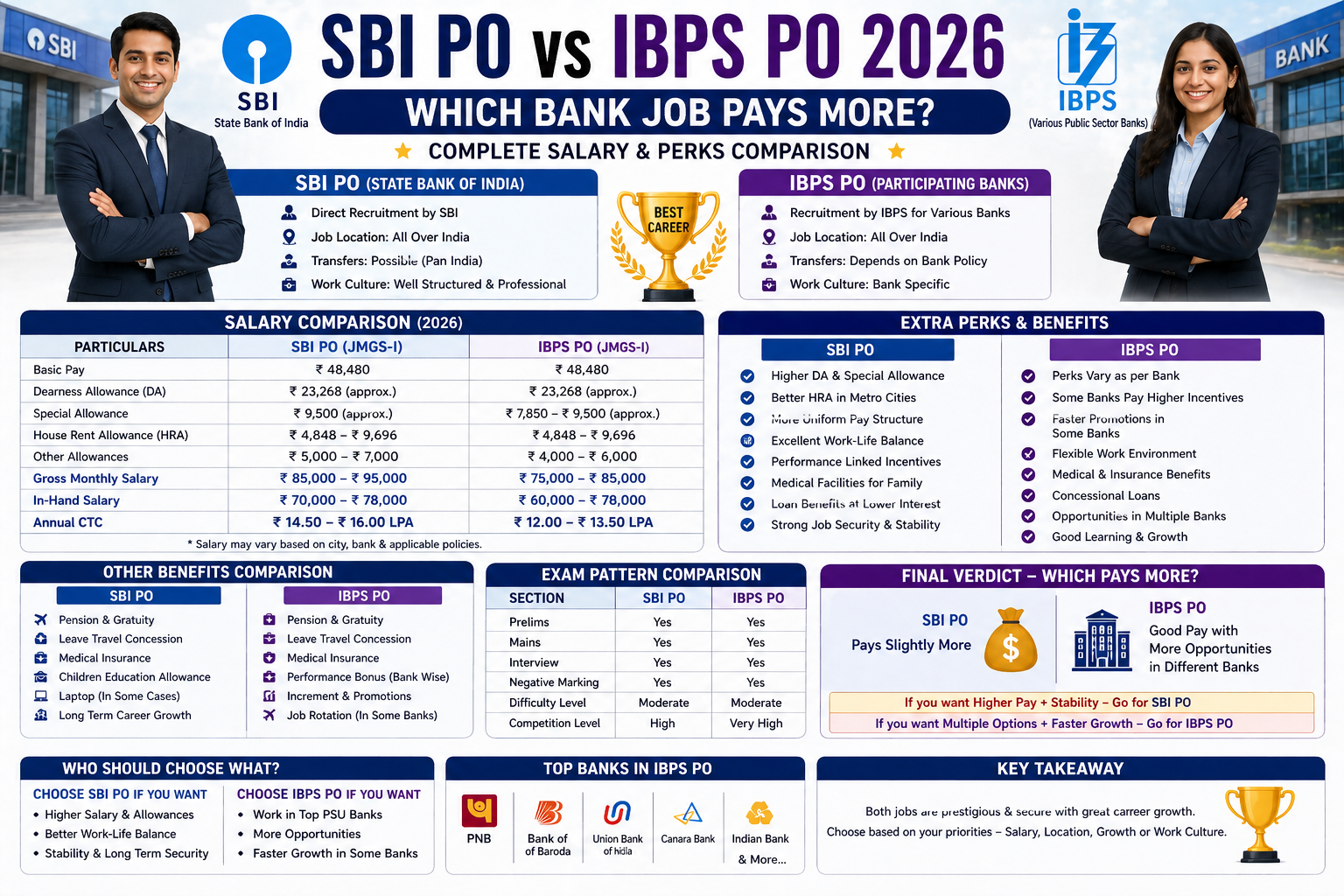
| Starting Basic Pay | ₹48,480/month | ₹48,480/month |
| Pay Scale | ₹48,480–₹85,920 | ₹48,480–₹85,920 |
| Annual Increment (Year 1–7) | ₹2,000/year | ₹2,000/year |
| Annual Increment (Year 8–9) | ₹2,340/year | ₹2,340/year |
| Annual Increment (Year 10–16) | ₹2,680/year | ₹2,680/year |
| Max Basic Pay at Scale I | ₹85,920 | ₹85,920 |
On paper, the basic pay and pay scale are identical for both SBI PO and IBPS PO. The real difference begins when you look at allowances and perks.
Gross Salary & In-Hand — Where SBI Pulls Ahead
Despite identical basic pay, SBI PO earns significantly more in total gross salary because SBI pays higher allowances than most IBPS-affiliated banks.
SBI PO Salary Breakdown 2026
| Component | Metro City | Non-Metro City |
|---|---|---|
| Basic Pay | ₹48,480 | ₹48,480 |
| Dearness Allowance (DA) | ~₹19,300 | ~₹19,300 |
| House Rent Allowance (HRA) | ₹14,544 (30% — Metro X) | ₹9,696 (20% — Urban Y) |
| Special Allowance | ~₹9,296 | ~₹8,200 |
| City Compensatory Allowance (CCA) | ₹2,700 (Large City) | ₹1,500–₹2,200 |
| Petrol/Conveyance Reimbursement | ₹1,200–₹2,000 | ₹900–₹1,500 |
| Newspaper Allowance | ₹300–₹400 | ₹300–₹400 |
| Learning Allowance | ~₹1,000 | ~₹1,000 |
| Gross Salary | ~₹95,000–₹98,000 | ~₹85,000–₹90,000 |
| Deductions (NPS 10%, Tax, PF) | ~₹10,000–₹14,000 | ~₹8,000–₹12,000 |
| Net In-Hand | ~₹78,000–₹88,000 | ~₹72,000–₹80,000 |
IBPS PO Salary Breakdown 2026 (Standard Nationalized Bank)
| Component | Metro City | Non-Metro City |
|---|---|---|
| Basic Pay | ₹48,480 | ₹48,480 |
| Dearness Allowance (DA) | ~₹19,300 | ~₹19,300 |
| House Rent Allowance (HRA) | ₹8,726 (18% — varies by bank) | ₹5,818 (12% — varies) |
| Special Allowance | ~₹7,200 | ~₹6,500 |
| Transport Allowance | ~₹1,500 | ~₹1,200 |
| Learning Allowance | ~₹1,000 | ~₹1,000 |
| Gross Salary | ~₹72,000–₹78,000 | ~₹67,000–₹72,000 |
| Deductions | ~₹7,000–₹12,000 | ~₹6,000–₹10,000 |
| Net In-Hand | ~₹65,000–₹72,000 | ~₹60,000–₹68,000 |
The Salary Gap — By the Numbers
| Metric | SBI PO (Metro) | IBPS PO (Metro) | Difference |
|---|---|---|---|
| Basic Pay | ₹48,480 | ₹48,480 | Zero |
| Gross Salary | ₹95,000–₹98,000 | ₹72,000–₹78,000 | SBI pays ₹18,000–₹23,000 more/month |
| In-Hand Salary | ₹78,000–₹88,000 | ₹65,000–₹72,000 | SBI pays ₹10,000–₹16,000 more/month |
| Annual CTC | ~₹12.5–₹14 Lakh | ~₹9.1–₹10 Lakh | SBI higher by ₹3–₹4 Lakh/year |
SBI PO clearly pays more — both in gross and net terms — despite having identical basic pay. The higher HRA rate (30% vs 18%), City Compensatory Allowance, and additional SBI-specific perks account for most of the gap.
Perks & Benefits Comparison
Beyond monthly salary, the perks package is where SBI’s advantage becomes even more pronounced.
| Benefit | SBI PO | IBPS PO (Typical Nationalized Bank) |
|---|---|---|
| Home Loan | Concessional @ 1–2% below market (SBI’s own home loans) | Concessional @ 1–2% below market |
| Car Loan | Concessional @ reduced rate | Concessional @ reduced rate |
| Medical Aid Allowance | ₹2,000–₹3,000/month (SBI higher than most) | ₹1,500–₹2,500/month |
| Hospitalization Coverage | Full family — comprehensive | Full family — comprehensive |
| Petrol/Conveyance | Reimbursed (₹1,200–₹2,000/month) | Often not provided at junior level |
| Newspaper Allowance | Yes (₹300–₹400) | Yes (₹100–₹300 in most banks) |
| Mobile Reimbursement | Yes (₹500–₹700) | Some banks provide; most don’t at PO level |
| Leave Fare Concession (LFC) | Biennial (every 2 years) — generous | Biennial |
| Staff Quarters | Available in select SBI colonies | Available in select bank colonies |
| NPS Pension | Employer contributes 14% of basic + DA | Employer contributes 14% |
| Children Education Allowance | ₹100–₹1,000/child | ₹100–₹500/child |
| Club / Gym Membership | Available in major SBI circles | Varies widely by bank |
| Uniform Allowance | Not applicable | Not applicable |
SBI advantage: SBI’s own home loan at employee-concessional rates can save a PO ₹5,000–₹10,000 per month on EMI compared to market rates — a massive real-world benefit for anyone buying a home during their banking career.
Exam Difficulty Comparison
Both exams test the same core areas — Quantitative Aptitude, Reasoning, English, and General Awareness. But the selection processes differ in structure, making one more demanding than the other.
| Parameter | SBI PO | IBPS PO |
|---|---|---|
| Prelims | 100 questions / 100 marks / 60 min | 100 questions / 100 marks / 60 min |
| Mains (Objective) | 190 questions / 200 marks + 50-mark Descriptive | 157 questions / 200 marks + 25-mark Descriptive |
| Group Exercise | Yes — 20 marks (unique to SBI) | No |
| Interview | Yes — 30 marks | Yes — 100 marks |
| Total Selection Stages | Prelims + Mains + GE + Interview | Prelims + Mains + Interview |
| Vacancies (approx.) | 1,500–2,000 | 4,000–5,000 |
| Competition Ratio | ~45–60 applicants per seat | ~35–50 applicants per seat |
| Difficulty Level | Marginally higher (SBI has tougher Mains Data Analysis) | Slightly easier Mains |
| Cutoffs | Higher (due to fewer seats + SBI brand pull) | Slightly lower |
IBPS PO has more vacancies, which means a higher probability of selection for candidates of equivalent preparation level. SBI PO has fewer seats and attracts slightly stronger competition — but the salary reward justifies the extra effort.
Career Growth Comparison
This is where the long-term picture becomes critical. Both paths lead to the same officer grade hierarchy, but promotion timelines and opportunities differ.
SBI Career Path
PO Probationer → Junior Management Grade Scale I (JMGS-I) → Middle Management Grade Scale II (MMGS-II) → MMGS-III → Senior Management Grade Scale IV → Chief Manager → Deputy General Manager → General Manager → Chief General Manager → Managing Director → Chairman
SBI is the only bank in India where the Managing Director and Chairman are internal promotees — meaning a PO who joins today can theoretically reach the very top of India’s largest bank. No other banking exam offers this ceiling.
Promotion Timeline at SBI:
- Scale I → Scale II: Minimum 4 years (faster for toppers via fast-track)
- Scale II → Scale III: Additional 4–5 years
- Scale III → Scale IV: Additional 4 years
- Salary at Scale IV (Chief Manager after ~12 years): ₹1,10,000–₹1,40,000/month in-hand
IBPS-Bank Career Path
Same officer scale structure (Scale I through General Manager), but promotion policies vary by bank. Some banks have faster promotion tracks (PNB, Bank of Baroda have relatively structured timelines), while others have slower movement depending on vacancy availability in higher grades.
Promotion Timeline (Standard Nationalized Bank):
- Scale I → Scale II: 3–5 years
- Scale II → Scale III: 4–5 years
- In-hand salary at Scale III (Senior Manager after ~8–10 years): ₹90,000–₹1,10,000/month
Key Difference: SBI offers a single-bank promotion path with clearer milestones and more internal mobility (SBI has 17 circles across India, a foreign exchange department, NRI services, investment banking arm, etc.). IBPS-bank officers are tied to one bank — you cannot move from Bank of Baroda to PNB after allotment.
Posting & Transfers
| Factor | SBI PO | IBPS PO |
|---|---|---|
| Initial Posting | Any SBI branch in India (per SBI’s discretion) | Any branch of allotted bank |
| Home State Preference | State preference considered but not guaranteed | State preference considered; depends on bank |
| Transfer Frequency | Every 2–3 years (mandatory for officers) | Every 2–3 years |
| Rural Posting Compulsion | 2 years rural posting mandatory during career | Similar rural posting requirements |
| Metro City Posting | More likely given SBI’s large urban branch presence | Depends on bank and vacancy |
| International Posting | Possible — SBI has offices in 30+ countries | Possible in banks with international presence (BOB, PNB, IOB) |
Prestige & Brand Value
This is subjective but important in real-world career terms:
- SBI PO carries the brand weight of India’s largest and oldest commercial bank — universally recognized, respected by employers and public alike, and useful even if you leave banking for another sector
- IBPS PO at Bank of Baroda, PNB, or Canara Bank is also highly respected — but the specific bank name matters; some IBPS-allotted banks carry more brand prestige than others
For candidates considering banking as a long-term career, both are equally strong foundations. For candidates who might pivot to private sector, fintech, or corporate finance, SBI on the CV carries slightly more weight globally.
Which Should You Choose — Decision Framework
| Choose SBI PO if… | Choose IBPS PO if… |
|---|---|
| You want the highest in-hand salary at PO level | You want more chances of selection (3x vacancies) |
| You are willing to study harder for marginally tougher exam | You want a backup in case SBI PO doesn’t work out this year |
| Long-term career in one prestigious institution matters | You are open to working at any good nationalized bank |
| You want SBI-specific benefits (home loan, global postings) | You want to enter banking fastest and grow from within |
| You are strong in Data Analysis and Descriptive Writing | You prefer a more straightforward Mains pattern |
Bottom line: If you are a serious banking aspirant in 2026, there is no reason to choose between SBI PO and IBPS PO — prepare for both simultaneously. The syllabuses overlap by 85%+. SBI PO exam typically comes first (May–July 2026) and IBPS PO follows (October 2026). This means you can attempt SBI PO, and if you miss the cutoff, use the same preparation for IBPS PO a few months later.
Targeting only one exam is leaving a major opportunity on the table.
Important 2026 Exam Dates
| Event | SBI PO 2026 | IBPS PO 2026 |
|---|---|---|
| Notification | April–May 2026 | August 2026 |
| Application Window | May–June 2026 | August–September 2026 |
| Prelims | June–July 2026 | October 2026 |
| Mains | August–September 2026 | November 2026 |
| Interview | October–November 2026 | December 2026–January 2027 |
| Final Result | December 2026 | February 2027 |
| Apply At | sbi.co.in/careers | ibps.in |
FAQ — SBI PO vs IBPS PO 2026
Q1. Can I apply for both SBI PO and IBPS PO in 2026? Absolutely yes. Both exams are completely independent with different notification dates, application portals, and exam windows. Most serious aspirants apply to both every year. There is no restriction whatsoever.
Q2. Is SBI PO harder than IBPS PO? Marginally. Both have the same Prelims difficulty. SBI Mains has harder Data Analysis questions and includes a Group Exercise stage that IBPS does not. Overall, SBI cutoffs tend to be 2–4 marks higher than IBPS in the same year.
Q3. What is the salary difference between SBI PO and IBPS PO after 5 years? After 5 years, both post’s basic pay would be at the same point (₹48,480 + 5 increments of ₹2,000 = ₹58,480). However, SBI PO still earns more in-hand because the higher HRA rate, CCA, and bank-specific allowances remain proportionally larger. The gap persists throughout the career.
Q4. Which bank is best in IBPS PO allotment? Among IBPS-affiliated banks, Bank of Baroda and Punjab National Bank are generally considered the best in terms of salary structure, promotion speed, and branch network. However, allotment depends on your preference, rank, and available vacancies — not purely your choice.
Q5. Does SBI PO get a government quarter? SBI has staff quarters in select locations, but not all officers get them. Leased accommodation (where SBI pays part of your rent up to a ceiling) is more commonly provided in major cities. IBPS-affiliated banks follow similar policies varying by bank and location.
Final Verdict
SBI PO pays more. At the metro city level, an SBI PO earns ₹10,000–₹16,000 more in-hand than an IBPS PO every single month — a difference of ₹1.2–₹1.9 lakh per year. This gap compounds over a 30-year career into a substantial difference in lifetime earnings, home loan savings, and retirement corpus.
Beyond salary, SBI offers the stronger brand, the higher career ceiling (Chairman of India’s largest bank), and the largest branch network for career flexibility.
But IBPS PO is not a consolation prize. It offers ₹65,000–₹72,000 in-hand per month for a fresh graduate — which beats 95% of entry-level jobs in India. It is permanent, pensioned, respectable, and comes with comprehensive benefits.
For 2026, the smart approach is to prepare for both, appear in both, and accept whichever offers you the higher rank. A confirmed bank PO job at any PSU bank is an exceptional career foundation. An SBI PO job is simply a more exceptional one.
Preparing for SBI PO or IBPS PO 2026? Practice Quantitative Aptitude, Reasoning, Banking Awareness, and Descriptive Writing mock tests for free on PadhLe Buddy. Start today!